

Thursday, November 5, 2026


- Article
- Comments (0)
The dead of the night
AJIT SAHI | New Delhi, April 26, 2012 17:50
Tags : Dantewada massacre | Maoists |
Tags : Dantewada massacre | Maoists |
 Ajit Sahi, former Executive Editor of Tehelka, recalls the agony of the survivors of the Dantewada massacre of April 2010. He brings out the apprehensions of those alleged to be Maoists who are lynched mercilessly by the security forces in the name of encounters
Hacks must move as much among the unnaturally dead as the pathetically living. After all, it is our remit to report the tragedies of plane crashes, floods, sectarian violence, and, of course, wars. Few deaths are, however, more pointless, or horrific, than those of the last category. And what a war it gets to be when neoliberal governments pit men in boots against civilians that have armed, unwisely, to defend their homesteads and farms from predatory capitalism.
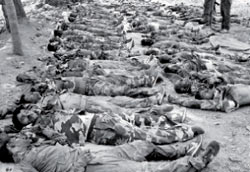
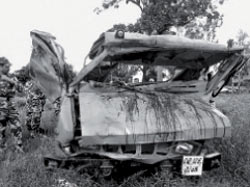 Once the government successfully instilled fear in the already jingoistic millions that the Maoists of the central Indian forests are bent on disintegrating India, it turned thousands of its uniformed men into lambs to the slaughter. In Chhattisgarh, it is now the archetypal class war, where the poor – the Maoists and the troops – kill each other so that the rich may gain. The most terrifying dance of death took place on April 6, 2010, when the Maoists ambushed a paramilitary patrol of eighty-plus in Dantewada, killing all but seven. Eighteen hours after the breakfast time massacre, I was sitting beside three of the survivors in a shabby government hospital in Jagdalpur town, a half-hour air ride from the killing fields. One had, among other grievous wounds, damaged an eye that would eventually be lost. Another had shed enough blood to urgently need life support that was simply unavailable at the cattle class facility. The third was woebegone with pain to pack much guttural punch. There were no doctors, nurses, ward boys or any other help at hand. No chief medical officer, no district collector, no superintendent of police, or anyone from the Central Reserve Police Force (CRPF), to which the men belonged. Two CRPF men, fortunate in that they hadn’t joined the ill-fated patrol, were the only other ghostly presence. I stepped outside into the dead of the night and looked around: Half a dozen CRPF men moved among the haphazardly strewn boxes, opening lids of ones already filled, checking their identities, slamming the lid shut, and pasting atop sheets with their names typed.
Only about fifteen of the 75-odd coffins had yet received their delivery and nailed shut. To me, that night among those men who had been pointlessly killed explained many things. One, the ill-paid and under-trained troops would scarcely find succour from the threat of execution at the hands of the well-entrenched Maoist rebels. After all, the patrol was attacked about a mile from its camp. If the government’s forces can’t secure the neighbourhood, just where would their writ run in the sprawling Maoist-run outback, which stretches across six states?
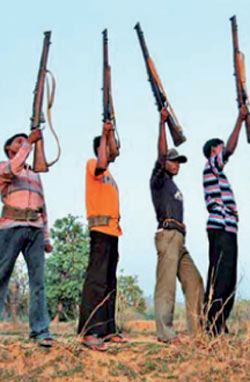 Two, this war would be settled only after far greater tragedies visit the poor, both among the tribal people that increasingly stream into the ranks of the Maoists, and the rural and urban unemployed. Predatory as well as retaliatory violence by security forces, especially in the last nearly eight years since the government-sponsored tribal militia, the Salwa Judum, was set up as a counterforce, have killed innocent villagers on an industrial scale. Even the judiciary is used to falsely imprison and try thousands of the poor tribal people whose rights to their homeland the Maoists are seeking to defend. But my most memorable lesson that night was that India’s vast middle classes are criminally complicit in this faux state war against India’s poor.
Fifteen months before my night among the dead, in January 2009, I had walked some twenty miles in the deepest forests of Chhattisgarh with a photographer and an American journalist to visit the site of an alleged killing of 15 tribal villagers by the Dantewada police. We had managed to find four survivors and had brought them along to that forested patch where policemen and their teenage tribal militia – known as Special Police Officers and since ordered disbanded by the Supreme Court – had allegedly lined up 19 people and opened fire. Dantewada Superintendent of Police Rahul Sharma had told us those killed were Maoists. But our interviews with the survivors established that most were innocent, and had died not in an exchange of gunfire but in cold blood, bullet to the head.
The views expressed by the author are personal


 Issue Dated: Feb 5, 2017

