



- Article
- Comments (0)
Bhubaneswar: Rising in east
The city of new temples
East is rising not just globally but also within India. Dhrutikam Mohanty explains Bhubaneswar’s emerging status as a learning hub
Tags : temples in odisha | IITs | XIMs | NIFT | AIIMS | Odisha Joint Entrance Examination | Associate Member of Institute of Engineers |
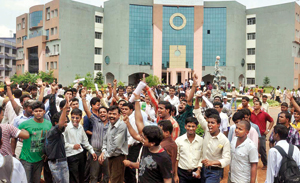 With over 500 odd temples dotting the landscape, it was once known as the city of temples. The number of higher education institutes has long surpassed the number of temples; their imposing granite architecture has been dwarfed by sprawling campuses; and the exquisite art works within the temple walls have been overtaken by the sheer volume of students that dot the city limits. Bhubaneswar seems like a city in a hurry to take on another identity in keeping with the times – that of the knowledge capital of eastern India.
So much so that the common refrain is that if there are three buses plying on the roads of Bhubaneswar, chances are that two of them belong to some educational institute or the other. From the IITs to the XIMs, from AIIMS to NIFT and from Institute of Life Sciences to some of the most prominent universities of the country – Bhubaneswar is today playing host to most biggies of higher learning in India. The last few years have particularly seen the city hone its image as an education destination, in many ways becoming what Pune is to students in western India – replete with swank campuses and students pouring in from across neighbouring Bihar, Jharkhand, West Bengal and even the North East.
Just one set of figures will indicate the growing popularity of Bhubaneswar as a knowledge hub for eastern India. This year over 96,000 students applied to appear in the Odisha Joint Entrance Examination (JEE), an examination for admissions into the most sought after management, pharmacy and technical courses in the state. The numbers are substantially more than last year when 86,000 students had applied for appearing in the JEE examinations. Interestingly, as many as 50 percent of the applications are from outside the state.
Compare these statistics to five years ago when the total number of seats in Odisha JEE was a mere 20,000 and the only 30,000 students appeared for the exam. Today, Odisha JEE has 50,000 seats on offer across the state, of which more than 30,000 seats are centered within the Bhubaneswar, Cuttack twin city region.
Clearly, the situation today is a far cry from the trend in 1980s and 90s when limited opportunities for even an engineering diploma or degree in the state saw scores of students opting for an AMIE (Associate Member of Institute of Engineers) certificate after availing coaching at Chennai. Coaching institutes in Chennai had it good with nearly 5000 students from Odisha converging here every season for coaching to pursue their ambitions. But the tide turned soon enough. “Mushrooming of private engineering colleges in Odisha in the 90s, specifically in capital city of Bhubaneswar, not only soaked up domestic students but also attracted students from neighboring states,” laments Dillip Pattnayak, who himself ran an engineering coaching institute in Chennai at that time.
Of course, like other state capitals, students from across Odisha had always been coming to Bhubaneswar for higher studies. But the popularity of many reputed learning centers such as Utkal University, Odisha University of Agriculture and Technology (OUAT), Institute of Physics, Regional Medical Research Centre et al, remained within the state boundaries. Old-timers believe that the transformation of Bhubaneswar into an educational hub began with the establishment of the Orissa Engineering College and the Xavier Institute of Management, Bhubaneswar (XIMB) in the mid-80s.
Says Prof. S.P. Mohanty, who has been teaching in various engineering collages in the state for over three decades now: “The Orissa Engineering College was one of the first ever efforts to privatise technical education. It provided an opportunity to study engineering not only to average students of the state but also out-state students, mostly from Bihar. That was when the process of transformation began.”

Today, Bhubaneswar is the abode of a slew of national institutes of excellence, among them the Central Institute of Plastic Engineering and Technology (CIPET), Institute of Life Sciences and the Indian Institute of Tourism and Travel Management (IITTM). The last few years alone have seen the city bursting at the seams with campuses of top notch institutes like the Indian Institute of Technology (IIT), National Institute of Science Education and Research (NISER), All India Institute of Medical Sciences (AIIMS), National Institute of Fashion Technology (NIFT), Indian Institute of Public Health, among many more. IIT Bhubaneswar is in fact one of the largest of the eight new IITs established in 2008–09. The self contained campus accommodates more than 10,000 students and 1,100 faculty members, making it the second largest of all IITs after Kharagpur.
Analysts believe that what has really put Bhubaneswar on India’s education map is the influx of private engineering and management colleges. The city today boasts of over 58 engineering colleges, 45 management institutes and 28 information technology centers approved by AICTE and Universities. These include several prominent private universities promoted by local entrepreneurs. The emergence of Bhubaneswar as an IT hub is also a big positive. Dr. Sarada Mishra, educationist and Chairman of Times Gurukul, observes, “It’s an ideal place to study so parents prefer to send their children to study here. With the arrival of MNCs and corporate houses, job opportunities have also expanded.”
Dr. Mishra adds that the state government should perhaps even contemplate special education zones and boost industrial growth even further. He has a point, given that the state’s education credentials have boomed alongside the government’s investor-friendly policies. Investments from Vedanta, Jindal group, Indal Aluminium, TELCO and a slew of IT majors have put the state on the fast track to development. This, combined with low cost of living, and low cost of education are key reasons for higher learning institutes to make a beeline for the state. “Despite cheaper fees, colleges don’t compromise on either infrastructure or quality of teaching, therefore it is a favourite destination for students of eastern India,” opines Prof. Debananda Beuria of Utkal University.
The Orissa Higher Education Vision 2020 moots the probability of a globally competitive higher education system in Odisha by 2020, including an international level knowledge hub in the Bhubaneswar-Cuttack-Khurda-Puri metropolitan region. It envisages that the hub would be comparable to the San Francisco Bay Area in the United States. A document of the Vision 2020 Task Force in fact lists over 60 new and already proposed universities, deemed universities and national institutes in Odisha. Some of these proposed projects include National University, Orissa Open University, Veterinary University, Orissa Health University, Vedanta University, ICFAI University, Sri Sri University and Xavier University among several institutions to be established by the central government, through public-private partnerships, or as private institutions.
However, the road to excellence is never easy. The last couple of years in particular have been a trifle difficult for engineering colleges in Odisha. After four years of consecutive increase in filling up all the allotted JEE seats, the year 2011 was a bit of a setback. Vinod Das, Secretary, Odisha Private Engineering Colleges Association (OPECA) says, “Faulty admission policy adopted by some technology institutes and bad counselling process last year has left thousands of seats vacant,” adding that delay in conducting examinations, declaration of results et al, have made the situation worse for students. “The government should address these problems to keep Bhubaneswar's education hub status alive,” he points out.
But such problems take nothing away from the growing stature of Bhubaneswar as an emerging knowledge centre. The recent discovery of the ruins of the Puspagiri University, a prominent Buddhist seat of learning until the 11th century, in the districts of Jajpur and Cuttack (barely 50 kms away from Bhubaneswar), is a timely juxtaposition of the new with the old. Along with Nalanda and Takshila universities, Puspagiri ranks as one of the primary institutions of higher learning in ancient India. The ruins of its campus – so close to this city of new temples – are telling of the times to come.
With inputs from Gyanchand Mallick


 Issue Dated: Feb 5, 2017
