



- Article
- Comments (0)
The angry old man and us
Tags : Anna: 13 Days That Awakened India | ashutosh book | anna hazare fight against corruption |
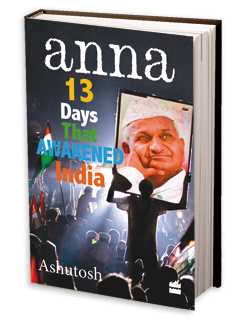 Anna: 13 Days That Awakened India
Ashutosh
Harper Collins
Edition: Paperback
ISBN: 9789350292150
Pages: 256
Price: Rs 199
Almost a century ago, there came a book titled Ten Days That Shook the World. Written in 1919 by an American journalist John Reed, it was about the 1917 Bolshevik revolution in Russia. Reed, a socialist at heart, not just chronicled the events and the actions of prominent Bolshevik leaders as a reporter but also analysed the entire movement that unfolded in front of his eyes with a partisan proletarian outlook. He had in fact confessed that his sympathies were not neutral. The book was received largely with praise though the political response was mixed. It became a worldwide reference guide then and for future generations to know about the revolution.
Ashutosh’s book on Anna Hazare’s now world famous tirade against corruption and demand for an ombudsman (Jan Lokpal Bill) has a resembling title – Anna - 13 Days That Awakened India. But the metaphorical similarity ends here. Not just because the socio-political-cultural context and situation is different but also because the revolution that forced Reed to sacrifice his objectivity was much more long lasting and brought massive socio-political changes worldwide whereas Anna’s movement seems to have lost its steam even though efforts to rekindle the fire post August 2011 are still on. But that has got nothing to do with Ashutosh’s effort to document, describe and analyse Anna’s sudden rise as the new hero of a nation so fond of hero worshipping.
Spread over 20 chapters, the book has facts and comments interestingly intertwined so much so that if one misses a sequence of events somewhere, he may lose the analytical part of it as well. It begins with establishing Anna Hazare’s identity. Using his journalistic skills of presenting television news, Ashutosh scripts an engaging flashback and dribbles deftly between many goalposts ranging from the alleged corruption in IPL, the UPA government’s ineptitude in dealing with corruption from local level to massive scams like CWG, 2G etc and gives the reader a background of the Anna movement.
What makes the book an interesting read even for those who do not support Anna is the style of weaving flashbacks within flashback. For example, the author while delving deeper to describe the malaise of corruption, goes back to his initial days as a reporter practising old school style journalism when television reporting, even though nascent, was not trivial. He travels back in time, moves in typical brownian motion from here to there, referring about almost all major political players and events of the 1990s (Narsimha Rao, Manmohan Singh, Amar Singh, VP Singh, Bangaru Laxman, the JMM MPs bribery case, to name a few) in a jiffy.
This Anna anthology does introspect about contemporary politics, albeit putting everything into perspective to highlight Anna’s famous August movement from the Ramlila ground in Delhi. This book will be of immense help to those who want to study a very important chapter of Indian democracy when the great Indian middle class, frustrated with the socio-political situation and angry with the political system, came out in the open to voice contempt for the khadi-clad netas that they had chosen as their representatives in Parliament. This short-term rising of the civil society was partially inspired by the public outburst in Egypt resulting in political turmoil that later engulfed the entire Arab world.
Ironically, like their Arab counterparts, the participants and the core group of the Anna movement, including Anna Hazare himself, did not have a clear blueprint of revolution and future actions which led to blurring of the sharp patterns that they etched on the pages of history. The Mumbai fiasco and later the absence of team Anna in the recently held Assembly elections has also been interpreted as the dwindling popularity of the ‘I Am Anna’ slogan and the taming of the tiger by the government. Anna’s detractors called him a media creation but the same media does not portray him as the unequivocal icon of the so-called second Independence struggle. A very routine coverage of Anna’s latest one-day fast at Jantar Mantar is a testimony to the decreasing media participation in the rabble rousing rumblings of the angry old man from Ralegan Siddhi.
But that does not take away any credit from Ashutosh for honestly documenting a spicy slice of a nation’s turbulent life. As a debutante on the pitch, he has shown good strokes.


 Issue Dated: Feb 5, 2017

