

Thursday, November 5, 2026


- Article
- Comments (0)
Tehran doesn't believe in threats
SAURABH KUMAR SHAHI | Issue Dated: April 22, 2012, New Delhi
Tags : Tehran doesn't believe in threats | US-based Iran analyst Cyrus Safdari | National Intelligence Analysis (NIA) |
Tags : Tehran doesn't believe in threats | US-based Iran analyst Cyrus Safdari | National Intelligence Analysis (NIA) |
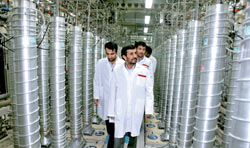 By putting irrational preconditions to its talks with Iran, the West has only strengthened the suspicion that all it wants in Iran is a regime change, says Saurabh Kumar Shahi
As the West and Tehran prepare for the next round of talks on the latter's civil nuclear programme, the most interesting statement has come from former International Atomic Energy Agency (IAEA) chief and Egyptian statesmanMohamed ElBaradei. In an interview given to German magazine Der Spiegel, ElBaradei talks about his own experiences in negotiating a deal with Iran. Claiming that while he had almost managed to broker a resolution on several occasions, considerations other than honest brokering derailed it. And then, he says something that several analysts (and this magazine), have been saying since the start of the negotiations. “They (US and the West) weren’t interested in a compromise with the government in Tehran, but a regime change – by any means necessary,” he declares. And this is what is going to define the fate of the negotiations in the offing.
 A lot is being said about the proposal and supposed shedding of grounds by both West and Iran. However, there is a pattern that has emerged in the negotiations that have taken place since 2003. In almost every negotiation, one can easily witness either raising the bar or shifting the goalpost altogether by the West. If experts are to be believed, this pattern has the realistic chances of playing out again in the current talks.
“This is pretty clear here. I for one have always questioned the intent of the West. For them, the goal is regime change and nothing else. Before every dialogue, as in this one too, they put a precondition. These preconditions are neither rational nor legally attainable. Even the West knows it. But they still keep the appearances so as to accuse Iran for the breakdown of negotiations,” says US-based Iran analyst Cyrus Safdari, while talking to TSI.
Let's look at some of the demands and Iran's response to it. American and other Western officials who will participate in the negotiations have put a few preconditions (or opening position, as Western media calls it). The most important among them is asking Iran to completely stop enriching uranium to 20 percent and deliver its already enriched stock to a third country or an international agency. In lieu of it, that third country will offer fuel to Iran to run its research reactors. It will also ask Iran to first close down and later dismantle its Fordow enrichment facility near Qom.
The Iranian position is still to shape up in the wake of the West's clear shifting of goal post following Iran's acceptance of a similar swap deal brokered by Turkey and Brazil the last time. However, according to Iran's nuclear chief, Fereidoun Abbasi, Iran is willing to accept part of the bargain by agreeing to stop its production of the 20 per cent-enriched uranium essential for a research reactor that is used to carry out research and production of medical isotopes for the treatment of cancer. However, he underlined that Iran in no way will stop complete enrichment programme and would continue toenrich uranium to 3.5 per cent that is used for generating nuclear power.
Says Javad Zarif, Iran's representative to the United Nations, “Iran has time and again gone above its international obligations and has allowed the IAEA to visit military sites unhindered. No other sovereign nation has allowed this to happen including the signatories and non-signatories of NPT. In fact, we have even moved beyond that. We allowed IAEA inspectors to collect environmental samples in order to prove that we don't have any clandestine intent. The IAEA on its part has maintained that they have no evidence whatsoever of an Iranian nuclear weapons programme. Is it not enough?”
Even US intelligence agencies have time and again maintained that Iran suspended its so-called nuclear weapons programme in 2003. Successive National Intelligence Analysis (NIA) reports have maintained that 16 US intelligence agencies among them could not produce so much as a single piece of evidence nailing Iran. Apart from that, recent surveillance operations, most effectively bydrones, have also failed to produce any evidence to that effect.
While the talks are still to commence, commentaries and analyses in the Western press indicate a disturbing trend. These commentaries are playing with two motifs that are contrary in nature. One set of it claims that sanctions have started to have a crippling effect on Tehran and thus Iran is yielding ground. The other set of commentaries maintain that Iranian leader Ayatollah Ali Khamenei is unwilling to shed ground and hence the negotiations will fail. This when Ayatollah Ali Khamenei has issued a decree against the research, production, stockpiling and use of nuclear weapons.
Such commentaries pose problems in negotiations. It only proves how the West wants negotiations to fail so that it can push for regime change. Under the circumstances, Iran has shown utmost patience while negotiating. It, for example, can always ask as to what does US and West have to offer in lieu on its suspension of enrichment. There is pretty little to offer. For example, Barack Obama on his part can not even guarantee a suspension of sanctions as it is Congress and not he who would decide. And Congress, embarrassingly enamoured to Israel by even its own standards in this election year, has no plan of lifting any sanctions. Iran knows this fact so does the West. But Iran never asked lifting of sanctions as a precondition. And this is where the contrast in intents becomes so blatant and visible.
And it does not stop here. The US Navy conceded this week that it has deployed a second aircraft carrier in the Persian Gulf region before talks have even started. The presence of the nuclear-powered Enterprise coupled with the Abraham Lincoln carrier strike group is a pretty unusual scenario as it has happened only a couple of times since its genesis that the Navy has had two aircraft carriers operating in the Persian Gulf. Such belligerence before the talks not only makes the environment unsuitable for talks but can also provoke Iran. This will only hamper the negotiations by adding to the trust deficit.
As talks unfold this week, it would be interesting to see how both the parties mitigate their trust deficit to work together. But in any circumstances, Tehran is not the one to capitulate under threat.


 Issue Dated: Feb 5, 2017

