


- Article
- Comments (0)
Tashkent Ahoy!
With a potent mixture of new and old, the city of Tashkent has something or the other to offer to travellers of every budget and taste, says Saurabh Kumar Shahi
Tags : Tashkent | Tashkent Agreement | Indo-Pak war | Lal Bahadur Shastri | Soviet Union |
 There is a flurry of images that the word Tashkent evokes inside the minds of every Indian: 1965 Indo-Pak War, the Tashkent Agreement, the sad demise of Prime Minister Lal Bahadur Shastri and the image of his body being flown back to New Delhi. That was 1965. After that there is nothing much to recall.
But while we were busy doing what we do, some tectonic changes occurred. The Soviet Union dismantled and Uzbekistan emerged as an independent nation with Tashkent as its capital. The 90s saw developments at breakneck speed as the newly independent nation was inspired to gift itself a city worthy of being a national capital. Tashkent changed, and changed for good.
First the essentials. Uzbekistan Airways runs direct flights between Delhi and Tashkent, as well as Amritsar and Tashkent. Being a relatively new airline, Uzbekistan Airways boasts of some sparkling new carriers, a mixture of Boeing, Airbus and Ilyushin, in its fleet. The flight from Delhi takes a little over two hours and the ticket prices are affordable. The Uzbekistan Embassy in New Delhi will be eager to provide you with visa and other travel related documents provided you are going there as a tourist. Individual travelers face little problem unlike some of the famous tourist destinations nearby. In fact, the liberal visa regime has seen sudden spike in number of Indian tourists who are flocking to Uzbekistan these days.
While in Tashkent, the only hurdle that you might face will be at the Customs. The law requires you to declare every penny that you are carrying inside the country. You have to sign a declaration form that has a counterfoil and keep a stamped copy with yourself. This copy needs to be returned when you leave the country. Also, once inside Uzbekistan, tourists staying for more than three days need to get registered with the bureau. If you are staying in a hotel, the onus lies on the hotel to do it for you. Once done, you are set to explore the queen of Central Asia.
Tashkent is a well-laid out city with broad boulevards and even broader squares. Taxis are affordable but motorbikes are a strict no no. City buses are in plenty with widespread routes. But the best option to see the city around is through city's well laid metro network. A mixture of Soviet era and modern routes, the metro can be used to visit almost all the areas of new city and the downtown and a few areas in the old city as well. And, like its counterpart in Moscow, the metro stations are in themselves a delight to see. Adorned with murals and engravings, and a design reflecting Soviet era aesthetics, each metro station represents a unique theme. But as much as you feel like doing it, it is strictly prohibited to click the pictures of metro stations. The security inside the network is unprecedented and tourists are advised to keep their travel documents handy.
You can cover some sections of the city on foot. In fact, if you divide the city between the old and the new part, you can actually cover each part on foot. The city has mild and pleasant summers and bitterly cold winters with the mercury dipping way below zero. The best time to visit the city is from April to September. As there is little or no humidity, the walks are pleasant and does not exhaust you beyond a point.
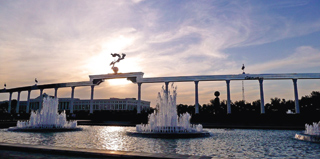
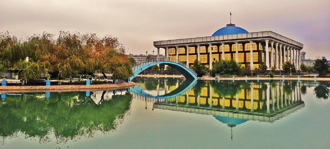
There are two squares that define the new part of the city and it is in between these two that many of the attractions are situated. The city's biggest square is Mustaqillik or Independence Square and it serves as the nerve center of the Uzbek government. Spread over an area of 30 acres by the side of the magnificent buildings of Government Secretariat and Oliy Majlis, the square draws substantial crowds at both daytime and evening.
Adorned with green zones and fountains the square is overlooked by the Arch of Independence. Nearby is the Monument to Independence and Humanism. There is a pedestal with a bronze replica of the earth on its top. On this bronze sphere, the territories of Uzbekistan are engraved. Prior to 1991, this pedestal had the statue of Lenin adorning it. Below is a statue of a seated mother with a child in her lap symbolising the new nation.
On its right is the Monument of Courage, build to commemorate the courage of the people who suffered the 1966 earthquake that almost flattened the city.
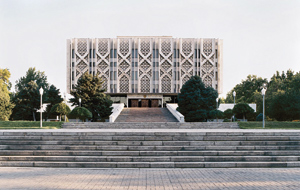
Further right is the World War II memorial dedicated to the fallen Uzbek soldiers. The monument consists of a flame and sad woman and a building with two corridors with the names of fallen written on it. The design is distinctly Japanese as it was constructed by the Japanese POWs. You can also catch a show in the adjoining Turkestan theatre which is well known for its aesthetics and acoustics.
The square is linked to another famous square, Amir Temur Square, through a boulevard locally known as Broadway. The city boasts of street artists and painters, who display and sell their original artworks. There are many shopping centers, boutiques and cafes around and spending an evening here is highly recommended. You can also catch street performers in the late evening. Also, this is the place where you can pick some good souvenirs and Soviet era antiques. You also have the Palace of Symposiums and National Library of Uzbekistan nearby.
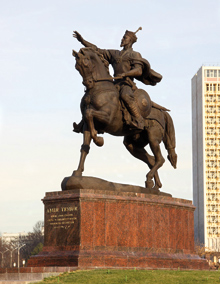
Amir Temur Square and the monument, as the name suggest, is dedicated to Tamerlane, who is considered a father-figure in Uzbekistan. In the center is a park with an imposing statue of Tamerlane. On the left is the museum dedicated to him. Towards the right are the famous Tashkent Chimes. Erected in 1947, the clock was brought from Konigsberg as a WW II trophy. Right in front is the International Congress Hall of Uzbekistan, an impressive building built to commemorate 2200th anniversary of Tashkent.
Those interest in art can decide to visit History Museum of the People of Uzbekistan as well as the Art Gallery of Uzbekistan which are not far. Both have exhibits worth spending time on. However, the trip to the city can not be completed without seeing a performance at the historical Alisher Navoi Theater. Once part of the famous Soviet Theater Troika, Alisher Navoi Theatre has kept the legend alive. Shows, a mixture of ballet, opera and others, are mostly in evening and the timings can be noted from its website.
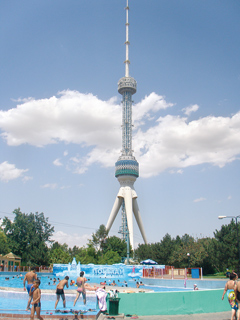
The old city has its own share of madrases and buildings worth visiting. But it is advisable to start with a modern structure before taking a full fledged dip in history. The Tashkent Television Tower is a 375 metres high tower and is the tallest tower in Central Asia. The tower has an observation deck and a restaurant from where you can take a sweeping view of the city and beyond.
Of the several madrases complex that adorn the city, Kukeldash complex has its own importance. Erected in 1570 by Governor Dervish Khan, known as Kukeldash, or “milk brother” of khan, the complex was razed to ground and re-erected several times. It briefly served as a caravanserai for merchants passing the Silk Route, but was later converted into a of Kokand khans. The architecture is breathtaking and so is the calligraphy that adorns its large gates and inside. On its right is historical Friday Mosque with a very Russian design and an open large courtyard.
A road joins the complex to the historically renowned Chorsu Bazaar. You can enjoy the hustle bustle of the daily Uzbek life at this road as well as the Bazaar itself. The street is full of farmers selling their latest harvest of melons, arguably the best in the world. You also have a leather garment market in the vicinity where one can get some good deals.
Chorsu bazaar has remained the busiest bazaar in Central Asia on the Silk Route. It still keeps that title. It was erected at the juncture of four roads (Chor=Four) centuries ago and still adorns the same site. However, modern buildings came up when the old building gave way. There is pretty little that you can not find in this market. Spices, vegetables, dried fruits, traditional and modern apparel, carpets, jewelry, ceramics, pottery, national costumes, housewares; Chorsu has it all. Raisins, apricots and saffron are a must buy. And so are the local “Itr”. Dagger enthusiasts can select from a wonderful collection of daggers and swords that come in all sizes and shapes.
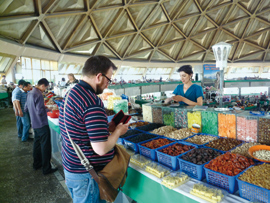
And if you prefer authentic roadside food over proper diner or restaurant, this place spoils you with choice. Particularly recommendable are Plov, much like our Pulao only much better, and Meat Samsa—from which our own Samosa came into being. The food should always be followed by a selection of melons that Uzbekistan produces. You’ll also find many choykhana or ‘tea houses’ offering a range of teas to seal the meal.
You can take a bus from there to visit the Khazrati Imam Complex. The whole complex, which consists of Barakhan madrassah, Tilla Shaykh mosque, Muyi Muborak madrassah, tomb of Kaffal Shashi, Namozgah mosque, as well as newly built ’Hazrat Imam’ mosque and the new administrative building of the Muslim Board of Uzbekistan, can be covered in a couple of hours. Muslim travelers will find it worthwhile to see the original “Hazrat Usman Quran” that is on display here.
Those interested in nightlife will find out to their delight that there are number of good clubs and discotheques that the city boasts of. In fact, Tashkent doubles up as a sin-city in the night with no dearth of adult entertainment.
Others, more interested in shapes other than what night offers, can decide to take the newly opened “Bullet Train” to Samarkand and further to Bukhara. After the inauguration of this service, Samarkand essentially has become a day trip from Tashkent making it convenient for the travelers.
There is a snow capped mountain range nearby that offers great choices in winter and adventure sports. It's just a couple of hours drive and worth taking.
A little information about the currency. The Uzbek Som is a devalued currency even with the currency notes of high denominator. Be prepared that most of the outlets will only accept cash, both Som and US Dollars. The official exchange rate of Som is much lesser than the black-market rate. You will find these currency exchanger near every monument and bazaar. Use your discretion.
Hotels comes in all sizes and price and are mostly affordable. You can chose from a selection of Five Star hotels that are spread all over the downtown. Staying at the downtown has its own benefits. Everything is basically at your walking distance.
Tashkent offers a range of touristic options for tourists of all budget, requirements and taste. And because of its splendid connectivity, it can also be used as a base for further travels in Central Asia.


 Issue Dated: Feb 5, 2017

