



- Article
- Comments (0)
Strains of a hundred strings
Music has the power to dispel all negativity in the darkest of places, Abhay Rustum Sopori, scion of a legendary family of santoor players, tells Arundhuti Banerjee as he discusses his efforts to keep classical and folk music alive in trouble-torn Kashmir.
Tags : Abhay Rustum Sopori | Pandit Bhajan Sopori | Santoor | Kashmir | Indian classical music |
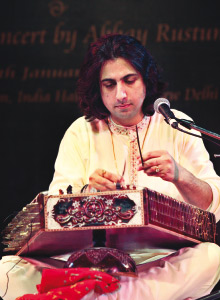 In January 1990, Srinagar-born Abhay Rustum Sopori, then in his pre-teens, visited Delhi with his family for their annual winter vacation. And he never returned to the Valley.
Militancy had engulfed Kashmir and his father, santoor maestro Bhajan Sopori, was transferred to the Delhi kendra of All India Radio. “We do keep going back to Kashmir but haven't been able to live there ever since,” says the santoor player, now in his early 30s.
Abhay's family has been playing the instrument for seven generations. His grandfather, Pandit Shamboo Nath Sopori, is regarded as a doyen of the Sufiana gharana. His father, having learned the ropes from an acclaimed master, has carried the family tradition forward over the subsequent decades.
Pandit Shamboo Nath Sopori, who had thousands of disciples in the Valley and elsewhere, was instrumental in arousing a keen interest among common people in Kashmir's rich classical and folk music traditions.
Bhajan Sopori, on his part, masterminded a musical renaissance in Kashmir in the 1970s. He took the santoor to new heights. The burden of this magnificent legacy sits rather easy on Abhay Sopori's shoulders.
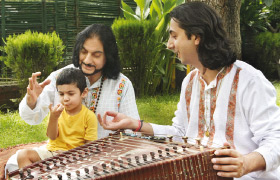 “My father once said that if you want to destroy a state, you do not need atomic power. All that you have to do is just dent its culture and the state will collapse automatically. I realised the value of that statement when I started visiting the border areas of Jammu and Kashmir” says Abhay.
The young musician has constantly fought to keep Kashmir's classical and folk music alive despite the many challenges that are posed by over two decades of unrest and official apathy. “I sing because I can,” he quips.
He credits his gharana for the quality of the work that he does. “People ask me whether the style of my singing is my signature. Actually it is very much a part of the Sufiana gharana that I belong to,” he explains.
The family runs the Sopori Academy for Music and Performing Arts (SaMaPa), which in recent years has been in the forefront of organising classical music soirees in the Valley against great odds.
The activities, which have continued amid militant strikes, army clampdowns and unending curfews, are a response to the lackadaisical manner in which the state government has tended to approach the task of promoting classical and folk music and its many exponents in Kashmir.
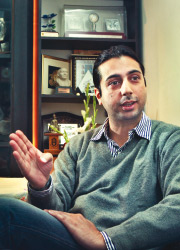 Abhay refers to an experience that he personally had with the officialdom in 2005 as the turning point. “I had been invited to a concert by the state government. The organisers told me that the response would be very good and that only 50 people would be in the audience,” he recalls. “I was dumbfounded. Just 50 people and they were saying the response was good?”
The same year at the SaMaPa Music Festival, Abhay saw for himself what exactly was amiss. He says: “I wanted to invite the then governor SK Sinha to the event. When I asked the secretary of the state academy about the possibility, he told me that the governor was not interested in attending a music festival. So I wrote to him personally. The governor confirmed that he would attend. It was obvious that some people were out to sabotage the event.”
As it transpired, the 2005 SaMaPa Music Festival was a roaring success with over 150 artistes in attendance. However, the media coverage left much to be desired. “The next day's newspapers had photographs of only the governor and me. They had nothing to say about all the other performers who made the show such a huge success,” says Abhay.
“Unfortunately, the media today is interested only in promoting known faces,” laments the much-awarded musician. “When I took up the matter with them, they told me point-blank that nobody wanted to read about unknown names.”
Abhay also realised that the reporters that had been sent to cover the SaMaPa festival had no basic knowledge about classical music. So he came up with the of idea an entire programme targeted at sensitising the media persons in question.
“I strongly believe that the media is the most important tool in the promotion of any artist or art form. So journalists have to be well versed with what they are going to write about. My programme bore fruit and there has been a visible improvement in the response of the audience and the quality of the media coverage since,” he says.
SaMaPa has also, over the years, succeeded in grooming many new musicians who have gone on to perform with legendary veterans with great distinction.
Abhay, however, has his own take on those that are famous in the realms of Indian classical music. “These well-known musicians use their fame to undermine their own craft and culture,” he says. “They play dirty politics to stay in the limelight at the expense of others.”
Abhay believes that the 'big names' of Indian classical music often gang up to keep musicians who are not part of their coterie away from the big festivals of the country.
“Many classical musicians,” he says, “have their own institutions that organise festivals. 'You scratch my back, I scratch yours' – that is the principle they follow. They promote members of their own coterie.”
As a result, at every major music festival of the country, connoisseurs get to see and hear the usual suspects. “The organisers argue that they need known names to pull in the crowds,” says Abhay. “But I don't buy that logic. How will newcomers ever come up if they aren't given an opportunity to perform before an audience?”
He also rues the fact that many great musicians are denied invitations to the big festivals because they aren't part of the charmed circle of the so-called popular artistes. “How many times,” he asks, “has the Delhi audience got the chance to listen to Falguni Mitra's dhrupad or Pandit Kartick Kumar's sitar? Ustad Abdul Halim Jaffer Khan came to play in Delhi after several decades at the SaMaPa Sangeet Sammelan some years ago,” he says.
He continues in the same vein: “Alka Deo Marulkar from Pune came here after a hiatus of than 20 years to perform in our music festival. What were all the other organisers doing during all those years?”
Abhay also makes no bones about his distaste for those that try to edge everyone else out of the limelight to further their own professional interests. He asks: “Do you know that there are many musicians who are ready to perform for free just to stay in the spotlight and not allow some genuinely talented artists to get a deserved platform?”
And what about corporate support for classical music? It is not always what it should be, says Abhay. “A company decides to mark its annual day by hosting a concert. It hires an organiser who can bring in some big names. But the audience that fills the auditorium isn't interested in classical music; it is busy eating, drinking and chatting while the artiste is performing,” he says.
Who is to blame for this sad state of affairs? It is time, he says, for all those who hold classical music dear to stand up and protest against such blatant disrespect for their vocation. “An artiste should never undervalue himself or herself no matter who is organising the concert,” he thunders.
In the context of the continuing unrest in Kashmir, Abhay believes that music can serve as a salve for the wounds festering in the hearts of the people. There is so much negativity among the youth of the Valley and that is what Abhay and his illustrious father have been striving to dispel through their work.
“Music has the power to refine the soul. Yes, I dare militants who try to lead the state's youth astray to test their resolve against the power of our music. It can destroy all negativity. All we have to do is make young people understand and appreciate the beauty and essence of our culture," he says.
Abhay visited a district jail to perform for the inmates. “When I went there, it was a difficult experience. You know I have seen expressionless faces, but these men and women had completely dead faces. It was very haunting and painful, something that I cannot express in words. I felt like running away from there…”
Yet, Abhay went to the stage and started playing. “I began interacting with them musically and an invisible bridge was built. At the end of my recital, I saw tears in the eyes of some of the female inmates. Some others had a twinkle in their eyes and a smile on their lips,” he recalls.
These inmates wanted to learn music from him, but their wish, unfortunately, remained unfulfilled because of security reasons.
His work with school and college children in the border areas has been hugely successful. “The response that I got from school-college students in these places was absolutely amazing. It made me both happy and sad. They are very keen to learn but there is nobody out there to teach them. The J&K Academy of Art, Culture and Language is not playing its role. We wanted to start a branch of SaMaPa there but no support was forthcoming from the state government”.
Abhay has written to J&K officials seeking help from them on different issues. More often than not, his letters have gone unanswered. “In fact, that is just as well,” he says. “In one rare letter, one official told me that Kashmir does not need music in order to earn revenue because it has tourism. The poor man has no idea what the proper promotion of culture can achieve for tourism. Really sad!”
To reach out to the younger people in the audience with Sufi music, he arranged 'Sufi Kinship', an ensemble with 35 musicians, in 2011. “I wish to do it every year, let's see. The experiment was very challenging and has been appreciated by many people,” says Abhay.
Winner of the Ustad Bismillah Khan Yuva Puraskar 2006, Sangeet Bhushan Award 2007, National Dogri Award 2008, J&K State Award (the highest Civilian Award of the State of Jammu & Kashmir, 2011) before he turned 30, Abhay does not measure his success by awards or the number of concerts he has in a month.
“The concerts give you money and awards place greater responsibility on you. But when my music brings a smile to a the face of a distraught prison inmate have, I feel truly satisfied and blessed,” he says.
Abhay listens to a lot of music. Does he listen to Rahul Sharma (Pandit Shiv Kumar Sharma's son)? “Well, I listen to the legends from whom I can learn something. Rahul… no," he says. Will we ever get to see them working together? “First of all our scale does not match, and let the organisers decide, who am I to say?”
Photos by: Mukunda De
feedback@thesundayindian.com


 Issue Dated: Feb 5, 2017

