


- Article
- Comments (0)
Robot capable of detecting diseases being developed
Tags : Cyberplasam | human diseases | Newcastle University |
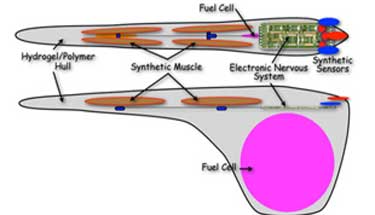
A tiny robot capable of acting like a living organism and detecting diseases inside the human body is being developed by scientists.
Called Cyberplasm, it will combine advanced microelectronics with latest research in biomimicry (technology inspired by nature).
Add to it an electronic nervous system, 'eye' and 'nose' sensors derived from mammalian cells, as well as artificial muscles that use glucose as an energy source to propel it.
"Nothing matches a living creature's natural ability to see and smell its environment and therefore to collect data on what's going on around it," says bioengineer Daniel Frankel of Newcastle University, who is leading the UK-based work.
"We're currently developing and testing Cyberplasm's individual components," says Frankel. "We hope to get to the assembly stage within a couple of years. We believe Cyberplasm could start being used in real-world situations within five years," adds Frankel, according to a Newcastle statement.
Cyberplasm is being developed over the next few years as part of an international collaboration funded by the Engineering and Physical Sciences Research Council (EPSRC) in the UK and the National Science Foundation (NSF) in the US.
The UK-based work is taking place at Newcastle University. The project originated from a 'sandpit' (idea gathering session) on synthetic biology jointly funded by the two organisations.
Cyberplasm will mimic key functions of the sea lamprey, a creature found mainly in the Atlantic Ocean. It is believed this approach will enable the micro-robot to be extremely sensitive and responsive to the environment it is put into.
Once it is developed, the Cyberplasm prototype will be less than one cm long


 Issue Dated: Feb 5, 2017

