

Saturday, October 24, 2026


- Article
- Comments (0)
India: Low Cost Manufacturing
Roaring tiger, disrupted
Cost of manufacturing in India is as low as that in China but this sector has so far failed to attract proper talent and consequently is a laggard
AKRAM HOQUE | Issue Dated: November 30, -0001, New Delhi
Tags : Roaring tiger | Cost of manufacturing in India | China's manufacturing abilities |
Tags : Roaring tiger | Cost of manufacturing in India | China's manufacturing abilities |
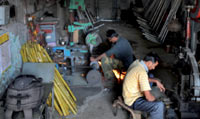 Both India and China are seen as potential and futuristic economic giants. But then, in spite of having an array of commonalities, the fundamental reasons behind this perception are different. While China is booming economically owing to its manufacturing abilities, India hinges around its service sector. However, of late, taking a cue from the Chinese, India Inc is also trying to strengthen their foothold in the manufacturing sector.
China is no longer a low-cost manufacturing hub of the world. A study conducted by AlixPartners, a global business
consulting firm, revealed that “China’s total manufacturing cost is now just six per cent lower than that of America”. Even nations like Mexico, Vietnam, Taiwan, Brazil and especially India are nearing China in the race of becoming the cheapest manufacturing destination. According to Chris Devonshire-Ellis, founder of Dezan Shira & Associates, the total cost of a 300 employee manufacturing plant is estimated to be around $2.2 million annually in China while a similar firm in India would cost approximately $345,782.
In the same light, Indian products apparently look expensive when compared to China as the manufacturing units have to suffer various external factors like red-tapism and lousy policies. Adding to the woes is excessive interference of middlemen in trading that leads to the escalation of the cost. The complex supply chain inflates the price of a product by 4-20 times. Thus, there is a huge gap between the cost of manufacturing and the retail price of a given good. In contrast, China has measures in place which effectively eliminate interference of middlemen. Moreover, the scalability of Indian producers is much lower as compared to the Chinese producers. Most of the Indian producers still operate from small units, relying heavily on age old, traditional methods of manufacturing and are not exposed to world-class technology.
Technical graduates are more inclined towards service sector leaving only handful of experienced (but unorganised) workforce to plunge into manufacturing. For instance, almost 90 per cent of the manufacturers in the textile industry are uneducated and lack technical expertise. Policies that encourage manufacturing (including incentives for manufacturers) can go a long way in making India a formidable force in the manufacturing sector.


 Issue Dated: Feb 5, 2017

