


- Article
- Comments (0)
Previous Cannes winners prove mettle again
Tags : Moonrise Kingdom | Cannes fest |Croisette | 65th Cannes Film Festival |Un Certain Regard | beyond the hills |
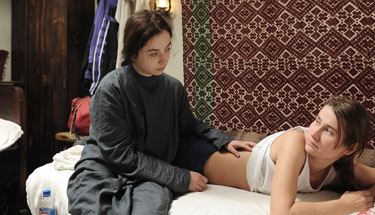 Two recent Palme d’Or winners, veteran Austrian director Michael Haneke and Romanian new wave poster boy Cristian Mungiu, have lived up to their reputation on the Croisette with their latest Competition films.
Haneke’s Amour, which premiered at the 65th Cannes Film Festival on Sunday, is yet another exquisite but heart-wrenching film from the master: it probes the incandescent power of love in the autumn of life.
Mungiu’s expectedly austere and understated Beyond the Hills focusses on the bond between two girls that is tested by the unbridgeable divide between religion and childhood friendship.
Mungiu had exploded on the global cinema scene when his second film, the abortion-themed drama 4 Months, 3 Week and 2 Days, won Cannes’ top prize in 2007, while Haneke has been a formidable presence on the international festival scene for several decades.
Haneke won the Palme d’Or in 2009 for the black-and-white period drama, The White Ribbon, set in a German village in the pre-World War I era.
While The White Ribbon was a German-language film, Amour, featuring 81-year-old Jean-Louis Trintignant and 85-year-old Emmanuelle Riva, is set in Paris and is in French.
The veteran actors play a couple – both are retired music teachers – whose love for each other is put under grave strain when the woman suffers a stroke. But the husband does not flinch one bit from the challenge of caring for his wife at home till the bitter end for she does want to be hospitalised.
The film’s pace and sound design heighten the poignancy of the situation as the man remains steadfast by his wife’s side even as her condition deteriorates steadily.
The film might not win the festival’s big prize, but the lead players would definitely be in the running for the acting awards.
Trintignant, who achieved international stardom in 1956 with And… God Created Woman opposite Brigitte Bardot, won the best actor prize in Cannes in 1969 for his performance in Costav-Gavras’ political thriller, Z.
Riva was last in Cannes way back in 1959 as the star of the Alain Resnais classic, Hiroshima Mon Amour.
Mungiu isn’t, of course, of the same vintage as aforementioned personages, but he is no less regarded for his proven directorial skills.
His control over the medium is full play in Beyond the Hills, set in a remote rural Roman Orthodox church, where a woman, Voichita, a novice in her 20s has committed herself to the service of God.
Alina, a friend and classmate from Voichita’s days in an orphanage, arrives from Germany to rekindle what has clear overtones of a same-sex bonding.
Alina wants to take Voichita away with her but faces stiff resistance from the chapel’s head priest as well as opposition, although far less insistent, from the friend herself.
Beyond the Hills seems well poised to strengthen Mungiu’s global standing despite not being quite as strong on impact as the director’s celebrated Palme d’Or winner. But it has enough style and substance as an exploration of the tug-of-war between monastic coercion and personal urges to strike a chord wherever it plays.
Like 4 Months, 3 Weeks and 2 Days, Beyond the Hills is filmed in long single shots, which allow the viewer the space to negotiate the moral and emotional dimensions of the questions that the film poses.
These questions are thrown up through the rapidly intensifying battle of attrition between the authoritarian but not necessarily cruel priest and the outsider who is threatened with being deprived of the love and companionship of the only person she holds dear in the whole world.
In the end, Alina goes over the edge, but the questions remain: has she lost her mind or is she possessed by the demon? The religious orthodoxy, as represented by the priest and his nuns, is understandably inclined towards the latter, but Mungiu leaves the issue open-ended for the audience. That strategy significantly enhances the power of this carefully crafted piece of filmmaking.


 Issue Dated: Feb 5, 2017

