


- Article
- Comments (0)
Pretentious Utopia?
Physical scuffles, sexual harrasment cases, protests and sloganeering are mere manifestations of jnu's decline writes Mayank singh
Tags : JNU | JNU student union | JNU mms scandal | student protest | pork and beef festival |
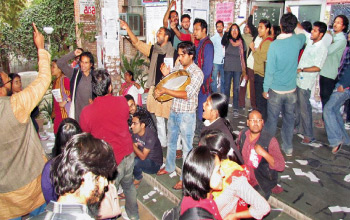 There was a time when if an attractive girl and a boy were having a heated exchange at midnight in JNU's humble but popular Ganga Dhaba, most onlookers would assume that the duo were arguing about the ramifications of the US policy in Serbia or pontificating on Russia's legacy of Communism.
But a similar situation today would not elicit such a calm response. Other students in the dhaba munching their Bread Anda snack would likely be wondering if this is yet another MMS scandal is in the making, a sexual harassment case or perhaps a love affair gone wrong.
Such presumptions instantly sum up the deteriorating situation within the various quiet, tree-lined walks of the academic blocks at JNU. The elite institution is reeling under intense media scrutiny after two consecutive years of MMS scandals. Last year saw a high resolution MMS featuring two JNU hostellers in a compromising position. In June this year, another video clip began circulating – that of an MPhil student getting intimate with his girlfriend. Both were reportedly studying at JNU's School of Languages.
If such vulgar displays were not enough, one only has to refer to campaign speeches in the recently concluded JNU student union elections to get aestimate of the decline in gender sensitivity on campus. Successive reports of the University’s Gender Sensitisation Committee Against Sexual Harassment (GSCASH) clearly show that sexual harrassment cases such as stalking, blackmail and sexist representation of women in posters have been on the rise in comparison with previous years.
The newly elected President of the JNU Students' Union V Lenin Kumar admits that such incidents have been maligning the name of the institution. “We have been taking steps so that such incidents do not get repeated,” he says. Shweta Raj, the student representative on the Gender Sensitisation Committee informs that on an average there are four to five cases of sexual mis-behaviour reported to their committee every month. However, she argues that the rise in sleaze on campus is a reflection of what is happening in the rest of the country. “We should not view JNU as an island, cut-off from the changes taking place in society,” she says.
And that is precisely the point. The Nehruvian dream of creating an island of excellence seems to be crashing around its ears. Forget academic excellence, JNU is now finding it difficult to even maintain its itellectually dynamic student community which once produced influential leaders of national politics, civil service and journalism solely on merit.
JNU's reputation as a place where democracy and dissent are celebrated today lies in tatters for this very reason. Pankaj Srivastava – a MA final year student of Hindi at JNU – came here from Allahabad University in search of a free atomosphere and intellectual stimulation. But he learned things the hard way. “I see scuffles happening at the slightest provocation and disagreement. I have come to understand that discussions here can happen only if they suit a particular ideology otherwise people will try to stifle your viewpoint,” he says sadly.
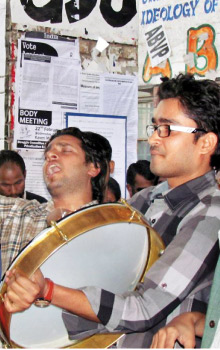 The lifting of the stay on JNU student elections since 2008 in December last year by the Supreme Court is already adding fuel to the fire. The last 12 months have seen a rush towards politicising the current students, influence their idealogy and involve them in big and small protests against the University administration and other issues. The 10-day hunger strike last month by students is a case in point. According to Lenin, there are some major demands pending for the last one year. “We want the administration to reduce viva-voice marks from 30 per cent to 10 per cent, increase the amount of merit-cum-means scholarship for students of economically weaker sections; assign grace marks for minority students, among others,” he elucidates.
Incidentally, the demand for reducing the weightage of viva marks came up after students concluded that the same was used as a discriminatory tool against students of SC, ST and OBC category. Caste and religion based outcries have in fact intensified since student politics gained momentum since the start of 2012.
Another recent brouhaha on campus was cooked up by a group calling themselves The New Materialists. The group which celebrates its first anniversary this Diwali dreams of annihilation of all caste and religious distinctions and removing the scourge of liberalisation, privatisation and globalisation. In their pursuit, the New Materialists recently tried to host a beef and pork food festival on campus and overnight shot to fame. Protests were staged by right-wing groups, the Rashtriya Goraksha Sena and others. Even the Delhi High Court jumped in and told University authorities to ensure that the festival did not take place. In retaliation, students supporting the movement staged a six-day hunger strike.
The mythological demon Mahisasur also became a matter of great acrimony this year. Students of All India Backward Student’s Forum – who believe Mahishasur to be the ancestor of tribals and backward communities – observed Mahisasur Day by portraying the killing of the demon as a story of ruthless suppression of one group by another.
Observers contend that the increase in instances of such caste and religion based appeasement is linked to the revival of student politics in the campus. "When the stay on JNU students' union was revoked, most political parties began raising issues in the run up to the elections in September. In this process several small-time parties without any vocal support in the university instigated issues to gain instant publicity, such as the Beef and Pork festival and the celebration of Mahishasur Day. These controversies were last seen during 2007 JNUSU elections," observes Sandip Kumar Singh, General Secretary ABVP in JNU.
There is a silver lining though. In the midst of these controversies and CAG allegations, the National Assessment and Accreditation Council (NAAC) has gone on to give JNU a cumulative credit point average of 3.91 out of four. But given the recent spurt in controversies, scandals and intolerance on the campus, it is unlikely that the new vice chancellor's dream of elevating JNU to the lofty position among the top 100 universities of the world can be realised anytime soon.
mayank.singh@thesundayindian.com


 Issue Dated: Feb 5, 2017
