


- Article
- Comments (0)
Movie Review: The Dark Knight Rises
Tags : The Dark Knight Rises movie review | batman movie series |
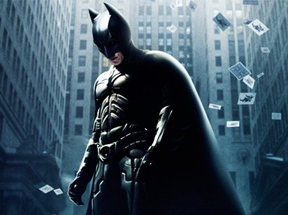 It is of no particular significance that the final chapter of Christopher Nolan’s Batman triptych has a scale that is epic. That was only to be expected. But does the much-hyped finale to a super-successful franchise have anything else to recommend itself to ‘non-believers’?
The Dark Knight Rises does have passages that are exceptionally compelling, but as a whole the film eventually leaves one with a gnawing sense that it has stretched itself too thin for its own good.
Bruce Wayne aka Batman, who had taken the fall for district attorney Harvey Dent’s wanton misdemeanors at the end of the last installment and retreated into oblivion, returns from eight years of inaction to take on a particularly destructive epitome of pure evil and save Gotham City from annihilation.
Is this Batman foe in the league of Heath Ledger’s The Joker, the icon of unbridled anarchy? Bane, played by English actor Tom Hardy (whose breakout performance was in Nolan’s 2010 film Inception), is no less venal and violent. Born in darkness, forged by sorrow and blind with rage against the whole world, he will stop at nothing to have his way.
Only the Caped Crusader can come between Bane and a neutron bomb trigger that he manages to lays his hands on and detach from its reactor parked in a highly secure lab. But the superhero is no longer quite the force that he once was: his body is under severe strain and his spirit is close to snapping point.
TDKR is about Batman’s struggle to rise from the depths of self-doubt, lift himself physically out of a dungeon he has been dumped into by Bane and go all out to redeem his reputation and reclaim his status as a savior of his dear Gotham City. The saga plays out on rather predictable lines although the closure that director and co-writer Nolan appends to the epic is as impressive as it is intriguing.
Nolan’s sweeping dips into the pop culture mythology tub are meticulously conceived and executed and TDKR achieves its surface grandeur without having to resort to an overdose of SFX. To that extent this film is a huge triumph of craftsmanship. But that’s de rigueur for the maker of Memnto and Inception.
The showpiece action sequences, characterized by the eye-popping technical wizardry that is an integral part of all superhero franchises, are staged with an eye on maximum effect. They are interspersed with pauses that present moments of intimate drama.
Especially memorable are the exchanges in Wayne Mansion between Christian Bale’s eccentric millionaire and Michael Caine’s Alfred Pennyworth, the family butler, as the latter strives to talk the protagonist out of slipping into his “cape and cowl” one more time and take on ferocious arch-villain Bane who has his mouth with a mask that looks like a dog muzzle. When he talks, he growls.
Besides the two central duelists, the sprawling TDKR storyline throws up an array of interesting supporting characters, none more so than jewel thief Selina Kyle/Catwoman, played with charm and enterprise by Anne Hathaway.
Also in the mix is the mysterious Miranda Tate (Marion Cotillard), whose back story, as it transpires, is as twisted as that of Bane’s. She provides some of the most pivotal twists in the tale, including a perfunctory and strangely coy and lifeless lovemaking scene.
And, of course, there are the stock characters that this Batman trilogy could not have done without – Police Commissioner James Gordon (Gary Oldman) and Bruce’s trusted adviser at Wayne Enterprises Lucius Fox (Morgan Freeman), among others.
Nolan tries to give his superhero action saga a contemporary political resonance by repeatedly alluding to, directly and otherwise, to post-9/11 terrorism, corporate greed and the Occupy Wall Street agitation. He often mines these stray references for mild humour.
When Bane and his men attack the Gotham city bourse, for instance, one shocked functionary there says: “This is a stock exchange; there is no money here to steal.” The villain’s riposte is fraught with contempt: “Then why are you people here?”
When Bruce Wayne is duped of his stake in the corporation that bears his family’s name, he is left with very little that he can call his own. But his mansion is still his. “The rich are never as broke as we are,” says Selina without batting an eyelid.
Bane subsequently mounts a full-on assault on the city with the help of escaped prisoners – felons and criminals that had been thrown behind bars in the course of eight years of repression unleashed by Gotham’s law enforcement agencies. The marauder claims that his intention is return control of the city to its exploited people.
The serious-minded elements serve to disguise the obvious trappings of conventional blockbusters that TDKR is built upon, but Nolan does not follow the political strands of the screenplay far and consistently enough to turn them into necessary arteries of the narrative.
TDKR is a treat on account of the sheer magnitude of its ambition, even if it tends to fall short on several counts.
Director: Christopher Nolan
Cast: Christian Bale, Anne Hathaway, Tom Hardy, Marion Cotillard, Joseph Gordon-Levitt, Gary Oldman, Michael Caine, Morgan Freeman, Liam Neeson
| Rating: | 3/10 |


 Issue Dated: Feb 5, 2017
