

Saturday, October 24, 2026


- Article
- Comments (0)
Medieval mindsets
The National Crime Records Bureau says a woman is raped every 23 minutes in India while one gets molested every 13 minutes. Puja Awasthi reflects on this disturbing trend.
PUJA AWASTHI | Issue Dated: October 28, 2012, New Delhi
Tags : rape cases in india | sexual violence | rape victims... |
Tags : rape cases in india | sexual violence | rape victims... |
 Many displays of Neanderthal mentality have been unwrapped and presented to the public by the spate of rape cases that have dominated news headlines these last few months.
Mamta Banerjee is a pro at it, having waded in first when her government announced a Rs 30,000 compensation for rape victims. From there she unraveled rapidly, first accusing the media of “inciting” rape, next calling for a shutdown of pubs to prevent rapes and then putting down the rising cases of rape in her state to increased interactions between men and women. While Ms Banerjee might be too busy to read this, I would like to share with her an ugly secret.
My introduction to the sexual nature of the human body was rude. It happened on an overnight train to a hill station, when a heavy arm reached across my berth for a savage grope. I was all of 13 and not part of, what Ms Banerjee in her wisdom has labeled, “an open market with open options”. The shame and fear of that night has remained in memory – a sharp, repulsive imprint that refuses to fade.
I do not expect Ms Banerjee to understand, but in a country which has been labelled as the "worst for women" (by a 2012 Thomson Reuters Foundation poll of the top 19 economies of the world), my rude experience is a memory shared by a majority of women. It is certainly not a creation of the media.
Going by just the records of the National Crime Record Bureau (NRCB), every 23 minutes a woman israped somewhere in India, every 13 minutes one is molested and every 53 minutes, one falls prey to sexual assault. As scary as these numbers are, they do not offer a true account of sexual crimes against women as most of these remain undetected and unreported. And when reported, such cases have revealed stupidity and insensitivity cutting cross gender and social divides. Here is a sample.
Ruling on the widely reported gang rape case of Bhanwari Devi (a village level development worker who was targeted for raising her voice against child marriages) in 1994, a district and sessions judge in Jaipur pronounced that: “Since the accused are upper caste men, the rape could not have taken place because Bhanwari was from a low caste.”
In 2005, the High Court in the country’s most literate state, Kerala, let off 35 accused who had raped a 16-year-old over a period of 42 days offering the phoney argument that the girl had many opportunities to escape which she had not taken, thus implying consent.
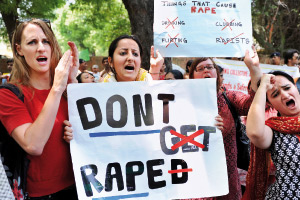 In July this year, Alka Lamba, a Congress worker who was a part of a team appointed by the National Commission for Women (NCW) to look into the molestation of a young girl in Guwahati, displayed remarkable lack of restraint and predictable apathy when she announced the name of the victim in a press conference. Not so long ago, policewoman turned activist Kiran Bedi, lashed out at the media for giving excessive coverage to “chotte se rape” (small rape) over larger issues of corruption.
Mulayam Singh Yadav, in the run up to the Assembly elections in Uttar Pradesh (a state that accounts for 7 per cent of all the country’s reported rape cases), promised, not stringent action against the perpetrators, but jobs to “educated” rape victims.
The rest of the world also offers numerous examples of this brand of oafishness.
Remember US Senator Todd Akin? He who spouted this bit of wisdom in a television interview: “If it’s a legitimate rape, the female body has ways to try to shut that whole thing down”. That “whole thing” being the reproductive system which, in Akin’s views, throttles the possibility of pregnancy in cases of rape.
In Tunisia, this October, a 27-year-old woman was charged with “intentional indecent behaviour” by two police officers who raped her in the presence of her fiancée. The charge means the officers are guiltless; the woman faces the possibility of six months in prison.
All of the above deride the black, stark truth of sexual violence which is that sexual assault, molestation and rape are neither pretty nor welcome. No woman, no matter what her sexual history, wants to invite rapes or molestations. The Congress Hissar district president Dharambir Goyat who, last week, declared that “90 per cent of rapes are (cases of) consensual sex between the girl and boy” has it completely wrong.
The all pervasive, dark ugliness of sexual violence cannot be explained by riders. It cannot be compensated. It cannot be erased. And it certainly cannot be commented upon lightly. Not by anyone. Not even if you are Amitabh Bachchan who had quipped something to the effect of “If rape is inevitable, lie back and enjoy it” in the context of his ill fated political outing.
Of the many solutions offered to counter rape, early marriages as proposed by the turbaned khap members of Haryana are certainly not viable, not just because they call for bypassing the country’s laws but also because they run counter to the science of female biology.
While increased gender sensitivity in our laws, police and courts, and an overhaul of moribund mindsets are the only long term solutions to turn the tide of sexual violence against women, the centre’s proposed scheme of financial compensation to victims of rape, intended as a system of ‘restorative justice’—a refined version of Mamata Banerjee’s interpretation is being experimented by some states.
In Maharashtra for instance, where it is called the ‘Financial Assistance and Support Services to Victims of Violent Crime’, based on parameters such as seriousness of injury, cost of hospitalization incurred by the victim, the emotional trauma caused due to the crime, the financial background of the victim, and the legal cost if any incurred by the victim, the amount of compensation can go upto Rs 3 lakhs.
Nirmala Samant Prabhavalkar, chairperson of the Maharashtra’s State Women’s Commission believes it is a “good scheme that would go a long way in helping women who are economically weaker” but adds that only swift prosecution that can stem the problem. “All rape cases should be dealt with fast track courts and there should be specific time limits to hear the cases and deliver justice”, she says.
To offer compensation as a one shot cure is raising political temperatures in West Bengal.The state’s state opposition leader Surya Kanta Mishra (CPI-M) says it is akin to the state attempting to “put price-tags at our women’s dignity.”
Congress MP Adhir Chowdhry dubs it “absolutely ridiculous” and a solution which “instead of providing a secure society is trying to safeguard culprits”.He explains: “A woman faces immense pressures when reporting a sexual assault. How is it expected that she would come forward to claim her compensation?” he asks. How indeed in a state where police officers who pursue rape cases are shunted to unimportant postings.
Jyothi Narayanan, co-ordinator of Kerala Sthree Vedi, a network of women activists says that compensation is a double edged sword. “Years back when the government announced a Rs 5,000 compensation for raped Adivasi girls, people circulated the slogan, ‘To rape an Adivasi girl, Rs 5000 is enough’. Society makes the life of such victims’ hell”.
The courts have also approached the issue of compensation casually. Mini Mohan, vice president and research co-ordinator, National Centre for Research and Development, Kollam, Kerala points out, “In practice the rate of compensation awarded by courts has been small. In one verdict it was as little as Rs 25,000. There is a lack of seriousness.”
Till we do not display seriousness in tackling sexual crimes, we all remain offenders. Whenever a sensational rape case makes headlines, there are debates on steps to check rapists. But little is done on ground. The number of rapes in India have doubled over the last two decades. For a nation that worships Durga and Kali, India is sadly a dangerous place for women now.
With inputs from: Snehangshu Adhikari (Kolkata), Chandran Iyer (Pune) and Sreekumar AT (Kochi)


 Issue Dated: Feb 5, 2017

