


- Article
- Comments (0)
Holy Motors livens up Palme d'Or race
Tags : Holy Motors | Cannes fest |Croisette | 65th Cannes Film Festival |Un Certain Regard |
 The 65th Cannes Film Festival has crossed the halfway mark. Frontrunners for the Palme d’Or are beginning to emerge.
After a somewhat tepid start, the festival has presented several award-worthy titles helmed by men that have been feted here before.
However, two acclaimed masters and past Palme d’Or winners Iranian Abbas Kiarostami (who is here with Like Someone in Love, shot entirely in Japan) and Englishman Ken Loach (The Angels’ Share) have delivered films that many critics feel are not quite up there among their best work.
French auteurs Alain Resnais, who is pushing the age of 90, and Leos Carax, on the other hand, have weighed in with two remarkable experimental but playful films, You Ain’t Seen Nothin’ Yet and Holy Motors respectively.
Resnais’s You Ain’t Seen Nothin’ Yet – the title is as tongue-in-cheek as anything else the film throws up – is a classy and masterful interpretation of Jean Anouilh’s play, Eurydice, played out on the screen by a bunch of neophytes as well 13 veterans who have at different points in their careers appeared in earlier productions of the play.
Michael Haneke will, as always, be in the mix when the jury goes into its final huddle. The Austrian auteur’s emotionally affecting Amour, an austere study of love in the autumn of life when disease and death loom large, is stunning in its craftsmanship. A best actress nod for 85-year-old Emmanuelle Riva looks a certainty.
The acting by the likes of Mathieu Amalric, Pierre ArditiSabine Azema, Anne Consigny, Lambert Wilson, Anne Duperey and Michel Piccoli is a delight to watch and you can barely take your eyes off the screen although the film does not offer anything more than a series of scenes from Eurydice.
Carax’s Holy Motors is something else. Rarely can there be a defiantly non-narrative film that is as riveting as Holy Motors.
If there is a prize for sheer audacity and visual power, his film would win the Palme d’Or hands down.
Even otherwise, this hypnotic film about a shadowy figure (played magnificently by Denis Lavant, a definite best actor contender), who seems to float from one incarnation to another, from one appointment to another, from one act of violence to another.
Although it is still difficult to call which film the jury headed by Italian filmmaker Nanni Moretti would pick for the Palme d’Or, both the titles quickly have made it to the list of award frontrunners.
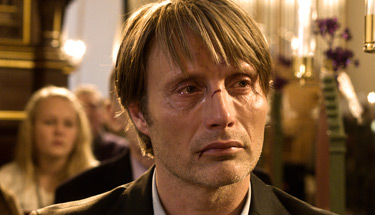
Also in contention would be the well-received Rust and Bone, directed by Cannes regular Jacques Audiard, and Thomas Vinterberg’s The Hunt, the first Danish-language film in Competition in some 14 years. The last one, Festen (Celebration), was also Vinterberg’s.
What is particularly noteworthy in The Hunt is Mads Mikkelsen’s performance as a primary school teacher in a small rural community who sees his life being torn asunder by a random lie that spreads like a virus.
Walter Salles’ adaptation of the Jack Kerouac novel, On the Road, Carlos Reygadas’s Post Tenebras Lux and David Cronenberg’s Cosmopolis are yet to be unveiled. So the race for the Palme d’Or is still wide open.
But this writer would dare to stick his neck out and put his money on Holy Motors. The pure visual poetry of Carax’s outstanding film would be difficult to ignore.


 Issue Dated: Feb 5, 2017

