



- Article
- Comments (0)
Haj, the fifth pillar of Islam
Tags : haj | islam | pillar |
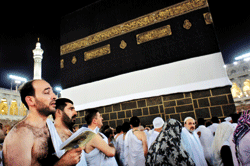 Haj is the largest pilgrimage in the world. It is the enjoined duty of every Muslim who is both financially and physically sound, to perform Haj once in a lifetime as it is the fifth pillar of Islam.
The five pillars are Tawheed (believe in one God), Namaz, Rozah, Zakat and Haj. Tawheed, Namaz and Roza are performed physically and only Zakat involves finances. Haj involves both physical and financial aspects.
Haj is a submission before God "Labbayka Allaahumma labbayk, labbayka laa shareeka laka labbayk. Inna al-hamd wa’l-ni’mata laka wa’l-mulk, laa shareeka lak (Here I am, O'Allaah, here I am. Here I am, You have no partner, here I am. Verily all praise and blessings are Yours, and all sovereignty, You have no partner).”
(Pilgrimage there is a duty men owe to Allah, those who can afford the journey; but if any deny faith, Allah stands not in need of any of his creatures.) [Qur’an 3: 97].
It dates back to 4,000 years. There was a city, where the present Iraq is situated, known as ‘Ur', a major centre of trade and industry. The society in 'Ur' was materialistic; people believed in many Gods and it was fragmented into a number of castes and creeds.
It was in this city and at this point of time that Prophet Ibrahim (Abraham) was born. His father was highly respected clergymen and held a senior post in the government. He did his best to reform the society and impress upon them the necessity to believe in a single God but failed to convince even his own father.
When he challenged everyone including the ruler, who was considered God, it was decided that he be burnt alive and was thrown into the fire but divine intervention rescued him and he came out of the fire safely.
In his later life, he underwent several tests but his belief in a single God was never shattered. He was not able to conceive any child from his first wife, Saira, but became father at the age of 80 when his second wife, Hajra, gave birth to his son Ismail.
It is believed that at the command of the Almighty, he took both his wife Hajra and infant son Ismail and left them in the desert with some water and dates. When Hajra asked him whether he is leaving them on the orders of Almighty, he replied in the affirmative.
After a few days, dates and water were consumed and little Ismail cried out for water. Hajra ran desperately between two hills, Al Safa and Al Marwah, in search of water and human help. She took seven rounds between these two hills and to her surprise, the Zamzam well was revealed with the rubbing of land with her child’s heel.
It is a tradition which has continued. Today, every pilgrim runs or walks seven times between these two hills and this is called ‘Sai’ which is now a part of a ritual of Haj and Umrah. As part of rituals, pilgrims also drink water from the Zamzam well.
Ibrahim again underwent a test when his son, Ismail, was 13 years old. He saw a dream in which he saw himself sacrificing Ismail and Ibrahim thought God was preparing him for the sacrifice.
Ibrahim took Ismail to Mina, a city adjacent to Mecca. During this journey, the Satan tried to distract him, and whenever it happened, Ibrahim threw stones at Satan. This is another significant ritual of Haj where every pilgrim has to throw stone at that site.
When he was ready to sacrifice his son, God asked his angels to send sheep for the sacrifice instead. This was considered his sternest test and it is in memory of this sacrifice that Muslims world over sacrifice on the 10th of the last month, Dhu al-hijjah, of the lunar calendar which is Eid Ul Azha.
When Ismail became young, Ibrahim told his son that God wanted him to build a house and sought his help. Both father and son started building the house and when this house, the present Khane Kabaa of Mecca, was complete, God asked his believers to perform Haj. So every year, Haj was performed from 8th to 12th of Dhu al-Hijjah.
During Haj, male pilgrims are required to dress only in the 'Ihram', a garment consisting of two sheets of white unhemmed cloth, with the top draped over the torso and the bottom by another sheet. Women are simply required to maintain normal modest dress and are not required to cover their hands or face.
The 'Ihram' is meant to show equality of all pilgrims in front of God; there is no difference between the rich and poor, the ruler or the common man. Ihram is also symbolic for its holy virtue and pardon from all past sins.
While wearing the Ihram, a pilgrim may not shave, clip their nails, wear perfume, swear or quarrel, have sexual relations, uproot or damage plants, kill or harm wild animals, cover the head (for men) or the face and hands
(for women).
The pilgrims perform Tawaf which involves all pilgrims visiting the Kabah and walking seven counter-clockwise rounds around the Kaaba. They may also kiss the Black Stone (Al Hajar Al Aswad) on each circuit. If kissing the stone is not possible because of the crowds, they may simply point towards the stone on each circuit with their right hand.
The place where pilgrims walk is known as "Mataaf". After the completion of Tawaf, all pilgrims offer prayers at the Muqaam (place) Abraham, a site near the Kaaba.
After Tawaf on the same day, the pilgrims perform Sai. Haj is an occasion when Muslims from from all parts of the world gather at Mecca and interact with each other.


 Issue Dated: Feb 5, 2017

