



- Article
- Comments (0)
Gandhi House in Kolkata up for auction
Tags : Gandhi House in Kolkata |
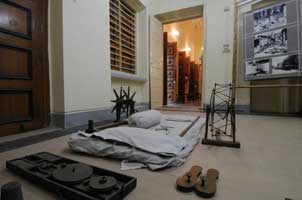
History has its charms but when it comes to hard realities, it often becomes difficult to pay for the upkeep. A small and unnoticeable advertisement about the auction of a house in a daily newspaper underlined this dilemma. The house in question was one on 150B Sureshchandra Banerjee Road at Beliaghata of east Kolkata, the one at which Mahatma Gandhi observed a fast on August 15, 1947 for communal peace and harmony. The house is set to be auctioned off by the United Bank of India for non payment of a mortgage taken out against it.
When the father of the nation arrived in the city to try and salvage the communal situation, he had asked his follower Kshitish Dasgupta to select a Muslim's House where he would keep fast. Kshtish selected the house in east Kolkata for the purpose. According to the Calcutta Municipal Corporation, the premises of Hyderi manzi, as the house used to be known, have 30 kattah open land, a pond on 30 kottah land and an adjacent 5567 square feet land as Muslim burial ground. Muslims of the city use this 30 kottah land as ‘Karbala Ground’ during Ramzan.
However, according to the Tivoli Court Branch of UBI, 16 kottah land of this premises was mortgaged by one Samarendra Kumar Ghosh, since deceased. As he failed to pay the mortgage, the bank decided to auction off the land. Says Ajitshwer Biswas, Chief Public Relation Officer of UBI, “The bank disbursed loan against official documents of the premises and now it has to get the money back. How can we go by the historic value of that property.” He has a point.
Veteran Gandhian activist Sailesh Chandra Bandopadhyay (86), who was Secretary of Gandhi Centenary Committee in West Bengal, has another vital point. “I don’t know how one Samarendra Kumar Ghosh become owner of this house and get Bank loan against official document. Can a Hindu become owner of a Muslim burial ground?” he asks.
Barun Dasgupta, son of Kshitish Dasgupta reveals something murkier. He says, “The Union Government, acting on a petition of Gandhi Centenary Committee, gave Rs 7 lakhs to the State Government in late 70s to renovate this house. If memory serves, former PWD minister Jatin Chakraborty had taken over the land and building to announced it as ‘heritage’. Former Governor of West Bengal Gopal Krishna Gandhi took special interest to increase Gandhian activities from this premise. The then PWD Secretary Alapan Bandopadhyay, who is still in an important post of the state government, was present in a meeting with Gopal Krishna Gandhi at Raj Bhawan, where I was also present. How then, after all that activity can the single premises of Mr Hyder in 1947 get fragmented?” The question, like all the others in this bizarre case has gone unanswered.
While the questions pile up, the inevitable reality that stares the patriot in the face is – who pays the bank? While the questions do need to be answered and nothing short of a full fledged enquiry will do, an immediate step has to be taken to stop the auction of this piece of history. There does not seem to be any initiative from the government either.


 Issue Dated: Feb 5, 2017

