

Thursday, November 5, 2026


- Article
- Comments (0)
Down Memory Lane in Lahore
Veteran journalist Shubha Singh, who has spent over two decades reporting on foreign affairs writes on the first bus yatra to Pakistan and how nothing has changed since then
SHUBHA SINGH | New Delhi, September 8, 2012 16:03
Tags : indo-pak relations | india pakistan bus service |
Tags : indo-pak relations | india pakistan bus service |
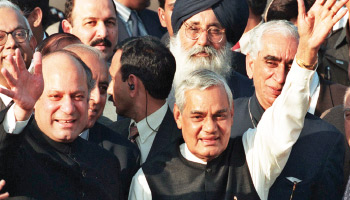 Relations between India and Pakistan tend to oscillate between moments of bonhomie and patches of tension. In over three decades of following India-Pakistan ties, one has seen periods of heightened tension and a few instances of goodwill and expectation. Atal Bihari Vajpayee’s bus yatra to Lahore caught the imagination of people on both sides, but the gesture floundered with the Kargil intrusions.
In early 1999, India-Pakistan ties were tense; India and then Pakistan conducted nuclear tests and declared themselves nuclear weapons states. There was a sense of alarm in foreign capitals at two nuclear powered adversaries in such close proximity, unlike America and the Soviet Union, who had distance between them as well as decades of experience of handling nuclear weapons.
The public mood in both India and Pakistan was roiled by hyper-nationalistic feelings after the nuclear tests. There was considerable international pressure on both governments to reduce mutual distrust. Both governments agreed on some confidence building measures – one was to start a bus service between Delhi and Lahore. It would open the road route that had been shut since the 1965 war. Pakistan’s Prime Minister Nawaz Sharif gave an effusive invitation to Vajpayee to travel on the first bus to Lahore and partake of the celebrated Lahori hospitality in the course of an interview he gave to Shekhar Gupta, editor of the Indian Express. Vajpayee accepted the unconventional invitation the same afternoon.
The invitation raised a roar of protests from hardliners on either sides. The Shiv Sena vowed to stop the Lahore bound bus on the road while there were demonstrations by Jamaat-e-Islami in Pakistan, which called for a strike on February 20, the day of the journey. The bus travelled under tight security.
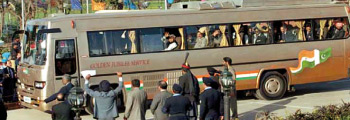 The bus journey from Amritsar to Lahore was rife with symbolism. Vajpayee decided to take with him a delegation of writers, poets, painters, sportsmen, actors and musicians. Dev Anand, Satish Gujral, Kapil Dev, Javed Akhtar, Shatrughan Sinha, Mallika Sarabhai travelled on the bus together with the officials and political figures. A large media contingent flew to Lahore and then by bus to Wagah.
The Wagah/Attari border looked like a glitzy wedding pandal and large crowds milled around on both sides of the metal gates. Viewing platforms had been erected for the media. The crowds enjoyed the tunes played alternately by the Pakistani Rangers and the Indian Border Security Force bands, some breaking into dance. The atmosphere was charged with anticipation and emotion. But the bonhomie did not please everyone.
My colleague and I watched a little sideshow that gave a clearer picture of the emotions aroused by the event. A smart young officer strode up to the Pakistan Rangers band and curtly directed them to continue playing without a pause. The genial looking master of the band demurred but then gave in as the officer’s face darkened in anger. The BSF band tried to play louder and the clash of sounds continued for a few minutes. The musical battle ended when the Indian side switched to relaying Hindi film songs on the loudspeaker.
Then the great gates swung open and the DTC bus rolled across the no man’s land. Sharif was waiting as the bus came to a stop. Vajpayee alighted from the bus and the two embraced. But their moment of glory was almost upstaged by the evergreen Dev Anand who appeared at the bus door. As he waved to them, a roar went up from the crowd and officials hastily whisked him away.
Sharif and Vajpayee then flew on to Lahore. There were now a few empty seats in the bus and I jumped on to get a feel of the bus ride. The ride into Lahore showed the mixed reactions; gaily waving passers-by interspersed with sullen faces.The Indian Prime Minister actually riding a bus to Lahore had enthused the Lahoris but the Jamaat-e-Islami held violent demonstrations, attacking government vehicles and cars of diplomats on way to the Government House reception. Despite the demonstrations, Lahore welcomed Vajpayee with open arms. His poem Jang na hone denge (We will not let a war take place) was received with thunderous applause and moist eyes. Earlier in the afternoon, Vajpayee had visited the Minar-e-Pakistan, the place where Mohammad Ali Jinnah had announced the resolution calling for the founding of Pakistan.
Dev Anand created a sensation as he walked along the streets of Lahore’s famed Anarkali. Indian visitors were welcomed on the roads, in shops. Two beaming Lahore matrons invited me home to tea when I stopped to ask them for directions. Other visitors reported similar outpourings of goodwill and hospitality.
The euphoria of the bus ride evaporated within days Kargil happened. The Lahore Bus Yatra came to be described as “Bus to Nowhere”. It had one lasting human impact though. It opened the bus route for ordinary people to go across the border.
India and Pakistan continue to struggle with a bilateral dialogue with the same list of agenda topics. The more things change in India-Pakistan relations, the more they remain the same.


 Issue Dated: Feb 5, 2017

