


- Article
- Comments (0)
Diary De Cannes
From the rolling of the red carpet to the unveiling of the masterpieces of the old and new, Saibal Chatterjee captures it all at the 66th Festival De Cannes…
Tags : Cannes | Amitabh Bachchan | Bollywood | Anurag Kashyap | Lunchbox | Gangs of Wasseypur | NFDC | Manjeet Singh |
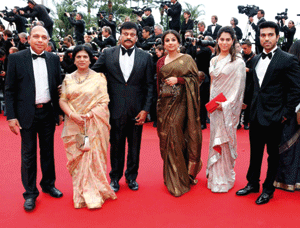
 The 66th Cannes Film Festival is officially celebrating 100 years of Indian cinema. Amitabh Bachchan walked the red carpet on a rain-soaked opening day for the screening of Baz Luhrmann’s 3D adaptation of F. Scott Fitzgerald’s, The Great Gatsby. But neither the actor’s role in the film nor the lukewarm manner in which the international media, here, responded to the presence of one of Bollywood’s most popular actors was anything to write home about.
As if on cue, it continued to drizzle for the second morning. The sun shone through the clouds by the afternoon. However, the brightness in the air had no effect on members of the Indian delegation as they listlessly flitted in and out of the India Pavilion in the hope of seeing some action. The Indian films in the Official Selection were Amit Kumar’s Monsoon Shootout and the four-in-one Bombay Talkies, which were screened during the week. In addition, India had a film each in Directors Fortnight (Anurag Kashyap’s Ugly) and Critics Week (Ritesh Batra’s Lunchbox). Given that none of the Indian entries here were star-studded films, the focus was expected to deservedly shift to the likes of Irrfan Khan and Nawazuddin Siddiqui, while Vidya Balan quietly went about her job as a jurist.
Both the Mumbai actors are in Lunchbox, while Nawazuddin also has roles in Monsoon Shootout and Bombay Talkies. Never before has an Indian actor been in as many films screened in the official sections or the parallel events in Cannes.
Significantly, Nawazuddin had two films in Cannes last year – Ashim Ahluwali’s Miss Lovely in Un Certain Regard and Kashyap’s Gangs of Wasseypur.
Old-time observers of Indian cinema were a little surprised that the only Indian films in Cannes were Hindi-language ones, if one discounts Satyajit Ray’s Charulata, screened in Cannes Classics. Many missed the linguistic and cultural diversity that Indian cinema was once feted for.
Top officials of the Indian ministries of information and broadcasting, tourism and the National Film Development Corporation (NFDC), played co-hosts at the opening night party of the Marche du Film (Film Market) on the evening of May 17th on the Majestic Beach here.
 It was only the second night of the festival and Indian filmmakers were conspicuous by their absence. They were, however, expected to be out in full force in time for the weekend when all the five films representing India in Cannes this year were scheduled.
Manjeet Singh, whose sophomore effort, Chenu, set in Bihar, is one of 15 projects from around the world that are in the 66th Cannes Film Festival’s l’Atelier, was the solitary standard-bearer at the market bash.
The Indian films scheduled for screening in Cannes got off the blocks with Anurag Kashyap’s Ugly, a psychological thriller that has thus far been under wraps back home. On the weekend, a restored print of Satyajit Ray’s 1964 masterpiece, Charulata, was unveiled in Cannes Classics at the Salle Bunuel. Also, on this day two first-time directors from India – Amit Kumar and Ritesh Batra – took their bows on the Croisette.
While Amit Kumar’s Monsoon Shootout , featuring Nawazuddin Siddiqui and Tannishtha Chatterjee, was accorded a Midnight Screening, Batra’s Lunchbox, starring Irrfan Khan, played as many as four times in Cannes Critics Week.
Both Monsoon Shootout and Lunchbox are among the 26 films screening across various sections of the ongoing festival that will be in the running for the Camera d’Or, the award given each year for the best debut-making director.
The week began with Bombay Talkies. The film by the four directors - Karan Johar, Dibakar Banerjee, Zoya Akhtar and Anurag Kashyap - was screened to mark the centenary of Indian cinema. Several interactions with the aforementioned contemporary Mumbai filmmakers was scheduled in the India Pavilion.
 Also, Anurag Kashyap figured in the Directors’ Assembly to be presided over by Costa-Gavras. Three other directors – Haiti’s Raoul Peck, Norway’s Joachim Trier and Mexico’s Amat Escalante (whose new film, Heli, is competing for the Palme d’Or) – were on the panel. The filmmakers shared their experiences in the course of a discussion on “How we can make independent films today”.
Telugu cinema superstar, Chiranjeevi, by his own admission, always dreamt of making a trip to the Cannes Film Festival. And it took him a career switch to get here.
The Union Minister of State for Tourism, who has been in office since October last year, was at the India Pavilion here as the chief guest at an event to announce the initiation of a process to ensure single-window clearance for all film shoots in the country. “I was an actor for 30 years and always dreamt of coming to Cannes,” the minister said. “I had to wait to begin a ministerial career for the wish to be eventually fulfilled. It is a great honour that India is a special guest country of the 66th Cannes Film Festival,” he said.
Referring to the move to rationalise filming permissions in India for foreign and domestic crews, he said, “We will remove all bottlenecks in the way to ensure that anybody who wants to shoot a film in India finds the going easy.”
The setting up of a film facilitation board would mean that a filmmaker planning to shoot a project in India will have to fill only a one form and make a single application to the nodal body.
The news that made a buzz and would be a delight for everyone back home was that if the Information and Broadcasting Ministry has its way, a special purpose vehicle would soon be put in place for organising the next International Film Festival of India in Panaji, Goa from November 20 to 30, 2014. This was revealed here by the Information and Broadcasting Secretary, Uday Kumar Verma. “The idea,” he said, “is to streamline the conduct of the film festival.” Among several other initiatives taken by the ministry, one is the setting up of a panel headed by a retired high court judge to recommend amendments to the Cinematograph Act of 1952. “India has changed completely in recent decades and it is, therefore, time to have a relook at the censorship rules. Eminent people like Sharmila Tagore, Leela Samson and Javed Akhtar are on the committee,” said Mr Verma.
“We are all for freedom of artistic expression, so the efforts would be to protect it even as efforts are made to prevent the medium of cinema being exploited by some elements to foment any kind of trouble in the country,” the I&B secretary said.
Well, with all the proposed changes in place, let’s wait for red carpet of one of the most awaited film festivals to roll open at home!
 The Lunchbox
Debutant Ritesh Batra’s The Lunchbox, was the best contemporary Indian film on show on the Croisette this year.
For those that have tired of the depredations of trigger-happy gangsters and the cacophony of cuss words in the so-called new Mumbai cinema and are baffled by Cannes’ lopsided take on what constitutes Indian films today, The Lunchbox was a welcome departure from the norm. Batra captures the urban landscape in all its variety without letting the images get the better of the emotions. Indeed, the best thing about the film is that director Batra is not afraid of ordinariness. In fact, he celebrates it whole-heartedly and, in the bargain, comes up with an acute study of urban loneliness that makes its point without the aid of gratuitous gimmicks.
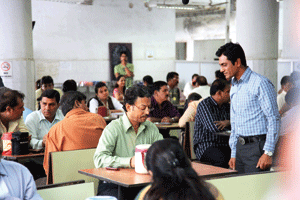
It is essentially the story of three individuals – Saajan Fernandes, a sullen government accountant who is a month away from superannuation; Ila, a spirited young housewife trapped in a loveless marriage; and a loner, Aslam Sheikh, who joins the former’s department as a future replacement.
The Lunchbox is a film that has clearly emerged straight from the heart. Therefore, even though the central trigger of the narrative – a meal dabba delivered to the wrong address – might call for a willing suspension of disbelief, the human core of the drama, always restrained and pointed, carries the film through.
The writing is precise and the characters, both the major and minor ones, are well etched. The Lunchbox provides Irrfan Khan and Nawazuddin Siddiqui the perfect stage to pit their skills against each other – the histrionic duet is a delightfully subdued affair and, therefore, that much more powerful.
The real revelation in The Lunchbox is Nimrat Kaur (last seen in Peddlers, screened in the same parallel section in Cannes last year).
She invests warmth and humour in the lonely housewife who seeks to use her culinary abilities to win her disinterested husband over, but finds an unanticipated escape route.
The Lunchbox, described by Batra as “a small film with an army of producers”, is truly fresh and delivers food for the soul.!


 Issue Dated: Feb 5, 2017

