

Monday, October 26, 2026


- Article
- Comments (0)
Decoding Communication: A fascinating journey
BACHAN THAKUR | New Delhi, September 22, 2012 14:45
Tags : Decoding communication | organizational communication | stress diffusion | N Chandramouli | organisational culture | organizational confidence |
Tags : Decoding communication | organizational communication | stress diffusion | N Chandramouli | organisational culture | organizational confidence |
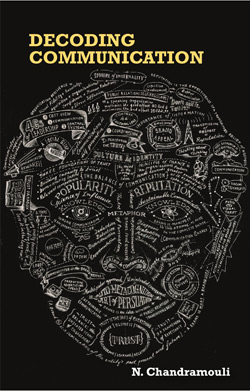
Communication is a universal remedy. It helps bridge relationships, sustain knowledge and also makes ‘chance’ more predictable. Communication builds a nourishing environment for organisations, brands and individuals to grow. ‘Decoding Communication’ is a book written by N. Chandramouli that explains ‘what’ should be done, ‘why’ it should be done and ‘how’ it should be done. Bachan Thakur of TSI interviewed the author who said that ‘Decoding Communication’ is a must read for anyone interested in understanding, influencing and managing communication.
Bachan Thakur: What made you write this book?
N. Chandramouli: Having an academic training in engineering and then into communications, I recognized the importance of theory - a process intended to set a firm grounding for a systematic approach to any subject. Its deficiency in communication unfortunately causes a significant transactional gap between teaching and doing, leading to a massive waste of communication effort and business opportunity. Decoding Communication is the cumulative result of my various research endeavors to understand and bridge this gap.
Bachan Thakur: How do you feel this book will help people in communication arena?
N. Chandramouli: Decoding Communication is meant for anyone interested in understanding, influencing and managing communications and through this book, I hope to help make communications more efficient and relevant. Presented here are some concepts that have been rendered redundant but now they are reenergized for modern application.Some new models have been introduced, which will bring a radical change in the way communication is transmitted and received. The book will help us all– the brand custodians, spokespersons, communication agencies, teachers and students alike, in the communication chain.
Bachan Thakur: Your book suggests six foundations to organisational resilience. Can you briefly sketch those foundations?
N. Chandramouli: Organisational resilience is the only shield that any enterprise has against the vagaries of the future. Usually, businesses only notice and address visible, direct, immediate and obvious stimuli, leaving the greater impact caused by the invisible, indirect, delayed, and covert stimuli unattended. These unknowns, which can be loosely clubbed as chance, are the reason for the seeming ‘randomness’ of life (and business). Organisational resilience is an organization’s dynamic state-of-being and not a trait, and therefore can be created and built. There are six foundation blocks for building organisational resilience and brands, which, if focus on these, will have a greater control over their own destinies.
These six organisational resilience foundations are:
1. Vision Fidelity: Keeping a close adherence to a well articulated organisational vision gives a higher Vision Fidelity.
2. Knowledge Acquisition: Since communication is the only means by which experiences can be shared beyond boundaries of time and space, it naturally becomes the source of all new knowledge acquisition. Knowledge is central to helping organisations mitigate risk, thereby adding to its resilience remarkably.
3. Organisational Culture: A culture of any organisation is set by its accepted norms of behavior and the values it sets for itself. Organisations with a strong culture have the ability to overcome almost any adversity.
4. Organisational Confidence: The confidence that an organisation demonstrates is intricately connected to its self-worth and belief in itself. Communication has always played the role of maintaining confidence in organisations, but its role in ensuring that individuals and teams with low confidence gain more confidence, is also a very earnest function it performs.
5. Human Relations: Since organisations are natural social collectives of people, Human Relations is one of the core foundations for any organisation. If human relationships are managed in an organization, it is equivalent to managing the organisation itself. The impact of dysfunctional Human Relations can be imagined when one visualizes several people in a company working at cross-purposes - not only will such a company have a diminished ability to counter any adversity, but it may even self-destruct.
6. Stress Diffusion: Stresses that are allowed to accumulate in an organization balloon into cumbersome crisis points, leaving it severely weakened. Conflict occurs when communication is misunderstood, is not used effectively, or its channels break down. In almost all stress situations, the answer to its diffusion is in (giving and getting) a different perspective - sometimes through counsel, sometimes through self-analysis.
Bachan Thakur: Can you please share in short the two Ws (What and Why) and one H (How) it should be done, which your book explains in detail?
N. Chandramouli: If we know what must be done, why it must be done and how it must be done in communications, it is possible to repeat results of any successful communication. These two Ws and one H are elaborated in Decoding Communication through 4 new Models of Communication being presented in the book - Brand Appeal Model, Perception Model, Propaganda Model and Trust Model. I strongly believe that this will alter the way people apply communication to situations.
Bachan Thakur: How this book will help readers in the art of manipulating words and how is it different from other books on communication in terms of making it an easy effort to learn quickly?
N. Chandramouli: Decoding Communication is written fluidly with anecdotes so that it helps learn faster. Communication is the art of managing transmission of thought and action of the communication source. This book will show practically how to do this better and if done with right effort, it can be a life changing experience. But it is not limited to organisational communication alone, for there have been several people who have told me how their personal relationships have changed for the better by applying this book's principles as well.


 Issue Dated: Feb 5, 2017
