



- Article
- Comments (0)
Book Review: Winter Evening
A bliss of solitude
Tags : Winter Evening movie review | Navtej Sarna |
 Author: Navtej Sarna
Publisher: Rupa Publications
Edition: Hard Cover
ISBN: 278-81-291-2047-2
Pages: 133
Price: Rs 350
There are books that are unputdownable – that compel you to keep going on and not stop till you have finished it completely. Navtej Sarna’s work is not one of those. There are books that take up great moral issues of the human condition and force you to think about them. Sarna’s latest work is not that either. Instead, what Sarna has come up with is a clean, unpretentious bunch of stories. Just that – no more, no less.
As stated before, it is not the kind of book that has you glued. The aptly named Winter Evenings aims for something a little more permanent. It is the kind of book that you keep in you book shelf and on cold winter’s evening, when you are alone in “vacant or in pensive mood” as it were, you make yourself a cup of coffee, pop it open to any page and start to read and let it fill your time with a warm glow. As such, it is rather a tidy effort.
The stories are poignant excursions into the way the human mind works. They are full of wit and humour and an almost lazy charm. Most importantly, they are completely unpretentious. Sarna does not try to blind you with the flash of his wit nor is he on a crusade to change the world. His stories exude a diffused yet warm glow. Each deep and insightful without pontificating or being overly judgemental.
Take the very first story for example. Two men, one a doctor and the other a clerk in a bank are stuck at a bleak little hill town. They have only each other by way of refined company even though they do not completely agree with each other. Saran employs a delightful technique of alternating between the points of view of the two men and paints a bleak yet beautiful picture.
Then there is the one where a writer who is also a diplomat gets a call from an old lady in Russia who tells him that she had met him once before. Realising that she has him confused with some other diplomat, the protagonist tracks the other man down to his home in Kalka. He finds the older officer’s widow who gives him a diary in which he had recorded his Moscow visit. The tale unfolds beautifully on the backdrop of wintry Moscow is juxtaposed with the hot and humid solidity of the small town in Punjab. In a way, the two different locales underline the two different lives that the older diplomat had lived.
Then, there is the one about the Sikh matriarch during the anti-Sikh riots of Delhi. Not only does it visit the beautiful relationship between the grandmother and grandchild, it also makes a very poignant connection between the riots and the carnage of the Partition. Sarna was not even born when the former happened but he was a government employee during the latter. He uses what he has read about the 1947 killings and merges it with what must have been a far more personal knowledge of the riots to show the inherent similarities in the two. Though he does not make any overt comment on the futility of the human addiction to violence, he does not need to. The way he structures his story and the way he ends it says it all too eloquently.
However, this is one of the few stories where Sarna makes use of the locale. As an officer with the foreign services, he must have had the opportunity to visit a lot of foreign lands and many of the stories are nominally set in these climes – Bhutan, Moscow, Geneva and Paris to name a few. But he resists the temptation to go into lengthy descriptions of the place, complete with street names and addresses. Clearly, it is not the places but the emotions that they invoke that interest the author. Thus, the locales are mere backdrops and never become important enough to take the focus away from the characters.
That is not to say that this is a perfect book. There are stories that do not exactly make the impression that they wish to. Some are not extremely original. For example, the story about the young couple who are living the high life and hiding the failure of their own lives in their fast living. The theme has been explored ad infinitum, and to better effect by many others, Tuman Capote to name just one.
However, perfection or brilliance is never the prerequisite in a book like this. In this case, it should be deemed successful if it can invoke a sense of languor and leave one thinking about human frailties and events and people in one’s own life. In that light, Sarna has succeeded. The book is well worth its place on a bookshelf.
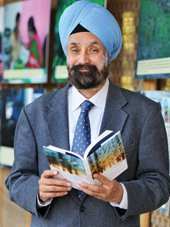 “Writing is in my genes”
Diplomat-turned-writer Navtej Sarna speaks to Agnibesh Das on juggling work and pleasure, different forms of writing and his passion for touching lives with the written word
You hold the post of an additional secretary in the Ministry of Foreign Affairs. How do you manage your busy work schedule and your writing?
I have been balancing my work with my writing for quite some time now and by now; I have got a rather good idea of how to do it. I have been writing since before I joined the MEA. It is about doing something that you really want to do, and so you find time – at odd hours, on weekends, in flights. It is also about managing your time. Once you do that, it is possible to do justice to both your job and your other creative exploits. I will not say it has been easy, but it is possible.
The setting of your stories in this book rarely play an important part in the narrative. Was that a conscious effort?
Yes, I have not mentioned any particular city or country except in a very few. There allusions and descriptions which give away the city, which I have not named, in some other stories – places like Geneva, Bhutan or Russia. It was not a particularly conscious effort, but for me, the important thing was that I was not writing about a particular place, I was writing a story. Sometimes, if you write too much about the place, you can take away the focus from the story. So wherever a place has been mentioned, it is to create the mood of the place. For example one story is set in Paris to bring that sense of abandon and romance that Paris is famous for, without naming streets and so on.
Was writing always the plan?
Well, it was always in my blood. My father was a writer, besides being a very senior government officer. So we always grew up with books. I started writing in some form or the other even when I was at university. I was doing a lot of journalism at that point. Then slowly I moved up the ladder and started writing short stories and then a novel. That is why some of these stories are very early stories – some of them written in the late seventies or mid-eighties.
Would you say your job helped you in your writing?
Absolutely. My job has taken me to a lot of different places, exposed me to a lot of different cultures. It has been a great advantage. You write what you see. So if you have not been to Russia and live in Nizamuddin, you are most likely to write about that.
How much of what you write is taken from your actual experiences?
See, if everything that is in the book had happened to me, I would have been finished long ago. I don’t think that anybody is such a pure fiction writer that whatever they write is completely from the blue – something that has never happened ever before. Usually how it happens is, you hear somebody talk about something, or you hear a bit of dialogue and that stays with you. Somebody says “Last night I got off this plane and I can’t tell you what I saw”. You hear this snippet and you start thinking – what did she say? That might lead you to a story. Some of these things have actually have happened. For example the story Raya where a strange Russian woman calls up an Indian writer – that really happened to me. A woman did call me up – not from Russia but from East Europe I think and asked me if she had met me before. And I began if it was a crank call or if she really did know someone. And that later became the story.
What are you more comfortable with – the novel or the short story?
They have very different demands. For example, I cannot write a short story on the computer, I write it by hand. But for a novel you cannot do that. I did not know how to write a novel, frankly speaking but I thought I could write short stories. But then publishers told me they could not publish a collection of my short stories, because people did not know who I was. I actually have letters from very prominent publishing firms in Delhi today telling me they could not publish my work. Everybody told me that I had the potential to write a novel, so finally, I wrote a novel.
Should we expect a work of non-fiction from you after you tenure at the MEA is over?
I have no such plans. I feel far more comfortable writing fiction. I do not have a very academic mindset and I find it very difficult to deal with things like bibliographies and footnotes. When I did do that, I found it very exacting and you have a certain kind of mindset for that which I do not have.


 Issue Dated: Feb 5, 2017

