



- Article
- Comments (0)
Africa attracts avid debate in Jaipur fest
Tags : Africa | attracts debate | Jaipur fest | jaipur literary fest 2012 |
One of the most interesting, albeit sparsely attended, discussion in this installment of Jaipur Literature Festival, was a session titled ‘A Good Man in Africa’.
As the name suggests, the participants tried to discuss some of the aspects of reportage and other forms of writings that have emerged out of African continent during the past couple of decades and how have they shaped, for good or bad, the discussions and the semantics surrounding this continent of more than 900 million people.
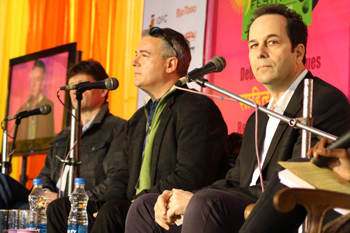 Moderated by Taiye Selasi, an up-coming African writer who showed utmost promise with her debut piece in Granta called ‘The Sex Lives of African Girls’, the session saw participation from noted American reporter Philip Gourevitch, known for his rattling pieces from Rwanda and Iraq; Philip Marden, travel writer and historian; Ilija Trojanow, writer and publisher, known for his seminal work ‘In Africa’; and of course Tim Butcher, journalist and writer based in South Africa who is considered my many, and rightly so, as the most erudite of the voices coming out of the continent these days.
The authors in general, and the moderator in particular, believed that the title of the session itself was problematic as it tries to club different countries and ethnicities in one single word “Africa”.
Gourevitch argued that he never calls his writings “writings on Africa”. He rather specifically mentions it as “reportage on Rwanda”. He maintained that this clubbing together is indeed a problem and not only has this led to reduction and over simplification of the problem, it also inspires the younger lot of journalists to keep seeing the continent as a monolith.
The most forceful argument was put forward by Tim Butcher who recounted the story of a British journalist who was supposed to be an expert on things pertaining to and from Africa. “He met me, expressed his delight and took out his notebook, and asked ‘tell me, how many people dead and from what tribe,’” recounted Butcher. “So that what it all boils down to. When we think of Africa, we think of tribes and killings. Agreed that the concept of modern nation-state is very new to Africa, but hang on, these rigid tribal structure is pretty new too,” he adds.
Philip Marden agreed that the concept of a national boundary with a flag and a football team is very new and it will take time for people to adjust. He also maintained that some of the fissures of tribal divide are the legacy of colonial era as colonial powers in their respective colonies tried to play up these divides in order to keep the opposition divided.
The session also saw some interesting discourse on the entire debate about the writing of western writers on Africa being treated as outsiders and see suspiciously by the locals. Gourevitch was of the opinion that this entire debate is futile as one can form an argument in reverse that in that case the Africans coming to the western world are outsiders so to say.
Marden also maintained that in his career he never felt unwelcome because of this outsider tag and in fact he saw people opening up to him naturally. On the contrary, Marden maintained, that these people were often frustrated about the way people are not interested in Africans or want to write about them.


 Issue Dated: Feb 5, 2017

