

Friday, October 2, 2026


- Article
- Comments (0)
Yemen's curse: water crisis
A Country ready to run dry
With water table levels falling to 1200 metres, Yemen may completely run out of water by 2020
AMIR HOSSAIN | Issue Dated: November 30, -0001, New Delhi
Tags : yemen | sana | water table level | |
Tags : yemen | sana | water table level | |
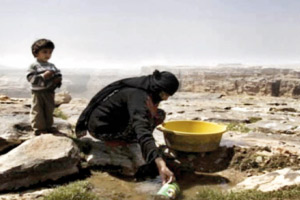 An already troubled nation as it is, Yemen has a bigger worry than the bane of terrorism – a nationwide backbreaking water crisis. A Yemeni government report in 2010 gave the initial feelers of the impending issue. The report highlighted how Sana, the capital city of the country might completely run out of water "in the coming decade" itself. Unfortunately, no significant improvement has taken place since the report came out. Even global concern and a change in the regime could not come to the rescue. In addition, enormous consumption coupled with poor management, growing population and the growing threat of climate change are going to make Yemen very soon the hardest place in the world to get a glass of water.
To recall some of the important facts; the annual per capita water availability in Yemen is only 140 cubic metres (for all uses) which is much lower than the Middle East average of 1,000 cubic metres per person yearly. Only 38 per cent of rural people have access to safe water while 59 per cent of urban people have access to the same. As the country has no permanent rivers, it massively relies upon groundwater extraction as well as rainfall and its diversion. But problems began to arise when the extraction of the underground water from a series of deep underground aquifers using electric and diesel-powered pumps began to be controlled by unlicensed and unregulated private companies rather than the government. The water tables plunged far beyond sustainable levels and the scenario went from bad to worse. For example, Sana's water table has dropped to 1200 metres in some areas compared to 30 metres in the 1970s. The crisis has paved the way for the emergence of a huge black market. The Yemeni government has made a few attempts to solve the problem. It created the National Water Resources Authority in 1995 and the Ministry of Water and Environment in 2003 apart from enforcing water laws to describe a licensing procedure for wells. Nations like Germany and Netherlands along with the World Bank have extended helping hands to implement comprehensive water policies which remain ineffective due to the sheer negligence of the
local government.


 Issue Dated: Feb 5, 2017

